Liposuction or an Arm Lift: Deciding When Your Arm Is Borderline

Start reading about sagging arms and two procedure names come up together. Most articles then end at “severe sagging means a lift, otherwise liposuction.”
Almost none of them say how severe is severe. In consultation, the largest group of people are somewhere in between. This article is about how to think through an arm that sits on that border.
The same sagging can have different causes
The cause has to be separated first. Which procedure applies is decided not by degree but by what is still there.
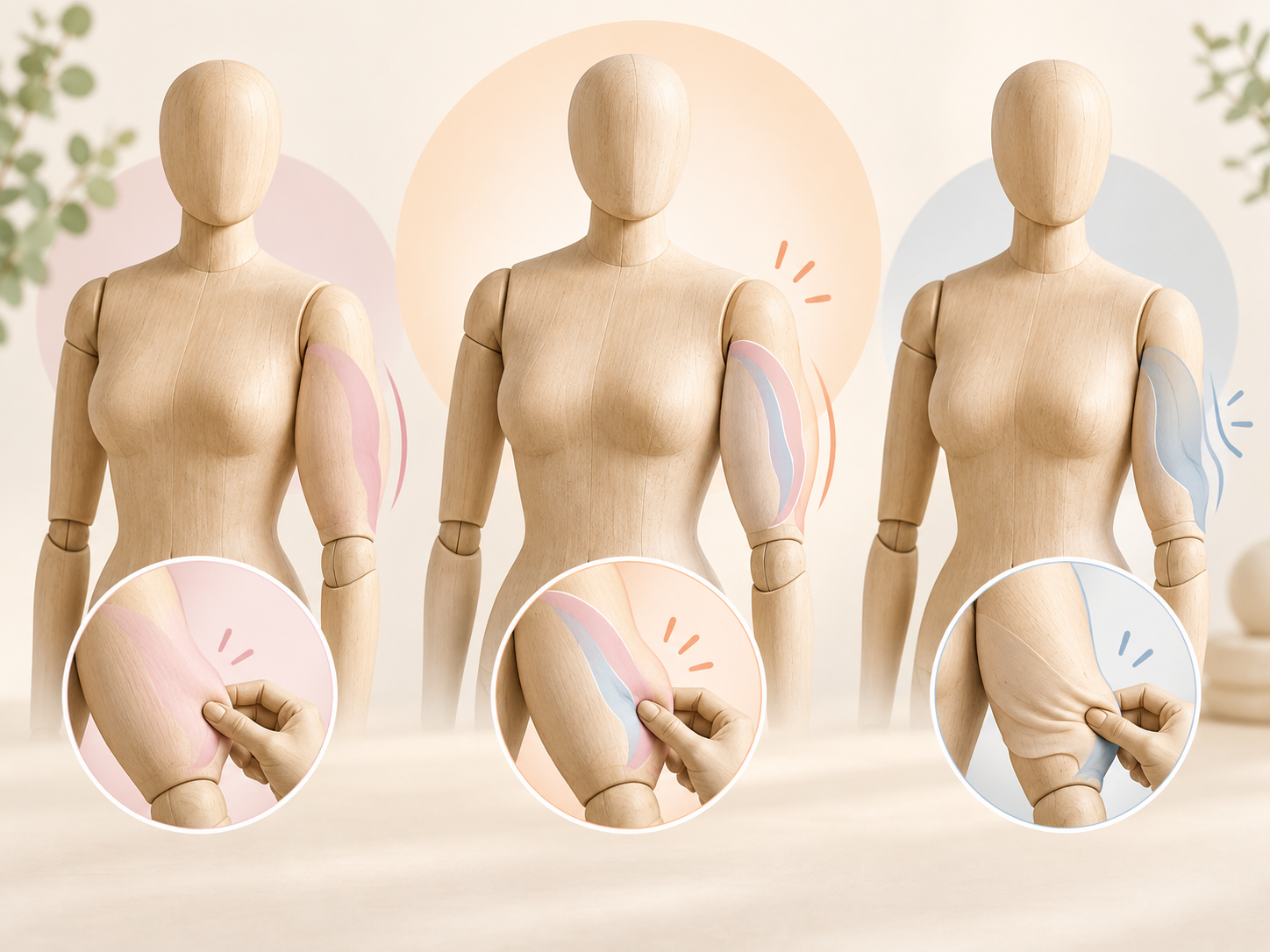
Where fat remains, the weight of it swings. Pinch the back of the arm and you get something thick, and how much it swings tracks that thickness. Reducing the fat reduces the swing along with it.
Where skin remains, it is different. The pinch is thin, but the arm ripples when you shake it. The skin has not tightened down over the space the fat vacated. Remove more fat here and the volume that was holding things up goes with it, making the loose skin more obvious.
The criteria that separate the two are tabulated in arm lift versus arm liposuction. This article deals with the cases in that table that straddle both columns.
What does borderline actually look like?
It is when the checks do not fall cleanly on one side but come back mixed. In practice this is the more common outcome.
The typical case pinches thick but ripples more than the thickness would suggest. Fat is still there and the skin has slack. It shows up often after a large weight loss.
Arms where elasticity has declined with age also land here. There is not much fat, but the skin no longer tightens the way it used to — so suction alone falls short of expectations while there is not enough slack to justify a lift.
Borderline does not mean both procedures are half-measures. It means closer to this: there is room to take them in sequence.
Can liposuction do it, or does skin have to come off?
Start with what each procedure targets.
| Category | Arm liposuction | Arm lift |
|---|---|---|
| What it reduces | Subcutaneous fat | Stretched skin |
| Incision | Openings a few millimeters wide | A line along the inner arm |
| Scar | Hidden in a crease | A visible length; 6+ months to settle |
| Limits on using the arm | Mostly lifted around suture removal | Longer, because of tension on the closure |
| Final assessment | 3 to 6 months | 6 months or more |
| At Line Culture Clinic | Performed | Not performed |
Take the last row first. An arm lift is not a procedure we perform at Line Culture Clinic. So this article goes only as far as separating which condition calls for which, and if the read is toward a lift, we tell you to have that confirmed somewhere that performs it.
Nor are we calling a lift a dangerous operation. It is a procedure where the extent of excision, the scar placement, the recovery burden, and the expected benefit all have to be weighed together, and that judgment belongs with the people who do it.
How different are the scars?
The biggest difference between the two is not the result but the scar and the recovery burden. For someone on the border, that difference decides a great deal.
A liposuction incision is an opening for the cannula, so it is small and placed along the inner arm or an armpit crease. With the arm down it folds away or is covered.
A lift has to remove stretched skin, so the incision runs as a line. Depending on the degree of sagging it may end short near the armpit or run down toward the elbow. An abdominal excision is largely covered by clothing; the arm is not.
We do not promise an invisible scar for either one. An incision leaves a mark. You have to decide in advance which bothers you more: the sagging, or the line.
There are shorter-incision versions of the lift, ending near the armpit. The scar is shorter, but so is the amount of skin that can be removed. Choosing that route to limit scarring can leave the sagging much as it was — so here too, the first thing to assess is how much skin there is.

If it is unclear, starting with suction is an option
This is the sequence we actually suggest most often to people on the border.
Address the fat first, then wait a few months. In that time, how far the skin tightens becomes visible. How much it tightens depends on age, on the elasticity you started with, and on how fast you lost weight — and it often comes back further than expected.
That leads to one of two outcomes. Either the sagging resolves enough that no second step is needed, or what remains becomes clear and the amount of skin to remove is less than first estimated. Neither is a loss.
The reverse order leaves no room. Tighten the skin first and remaining fat can pull the result away from what was planned — and what has been cut away cannot be put back.
That said, this sequence does not suit everyone. Where there is already a lot of skin slack, suction gains little and the waiting simply costs time. Where meaningful tightening is unlikely, planning both stages from the outset is better.
Age enters into it too. Skin tightens more on its own the younger you are, so the same degree of sagging leaves a different amount of room to wait and see.
Some arms need both
This is a step past borderline: clear remaining fat and substantial skin slack together, which shows up after a large weight loss.
Here too, sequence is the question. Reduce the fat sufficiently and then correct what remains, and you address not only the contour of the upper arm but the line running from elbow to armpit. The upper arm is the segment from shoulder to elbow.
Doing both on the same day is not automatically better. How much skin needs removing only becomes clear once the fat is gone. Decide in advance and you plan generously, and a generous plan means a longer scar.
People ask whether it is not better to finish in one go — one round of anesthesia, one recovery. That has its merits, but on the arm, splitting the sequence usually gains more.
What changes with age
Conditions shift over time. An arm that suits suction today will not necessarily suit it in a few years.
How far skin tightens on its own tends to decrease with age. For the same degree of sagging, there is less room to wait and see than there used to be. So someone on the border who puts it off for several years may by then have moved out of the range suction alone can address.
That is not a reason to rush, either. If your weight is still moving, deciding now is more likely to be wrong. Putting something off and waiting for it are different things. Waiting until the conditions are in place is how you acquire the evidence; postponing without a reason is how the options narrow.
Which of the two you are doing becomes clear by working through the conditions one at a time: whether your weight has settled, how long since the loss ended, how the pinch differs from the shake. There is individual variation, so this is hard to reduce to a number.
Is this even the time to decide?
One more thing to look at. There is a worst possible time to judge sagging.
It is right after weight loss ends. The faster it came off, the further behind the skin is, and that is when the arm looks loosest. Judge then and you read the skin problem as bigger than it is, and start considering surgery you do not need.
Skin does tighten over time. All the more so if your weight is still moving — because what is left, fat or skin, keeps changing.
So when people come in during that window, the conversation usually ends with looking again in a few months. Waiting is not a passive choice; it is the process of acquiring the basis for a decision.
There is a limit to judging thickness and swing on your own. How many millimeters the fat layer measures and how much skin is in excess only become visible once ultrasound separates the layers. That is why a consultation at Line Culture Clinic measures the layers and records photographs in each position — to tell you which condition you are actually in. If you seem to be on the border, let us decide together whether to split the sequence. You are welcome to get in touch.