How Long to Wear Compression on the Arm in Summer
For people having arm surgery in summer, the biggest worry is not scars or swelling — it is the compression garment. What happens when it gets sweaty? Will it show through clothing?
Look it up and you find the duration, but rarely what actually changes across that duration. The garment does a different job early than it does later, and summer has its own specific difficulties. Here they are in order.
Does wearing it make the result better?
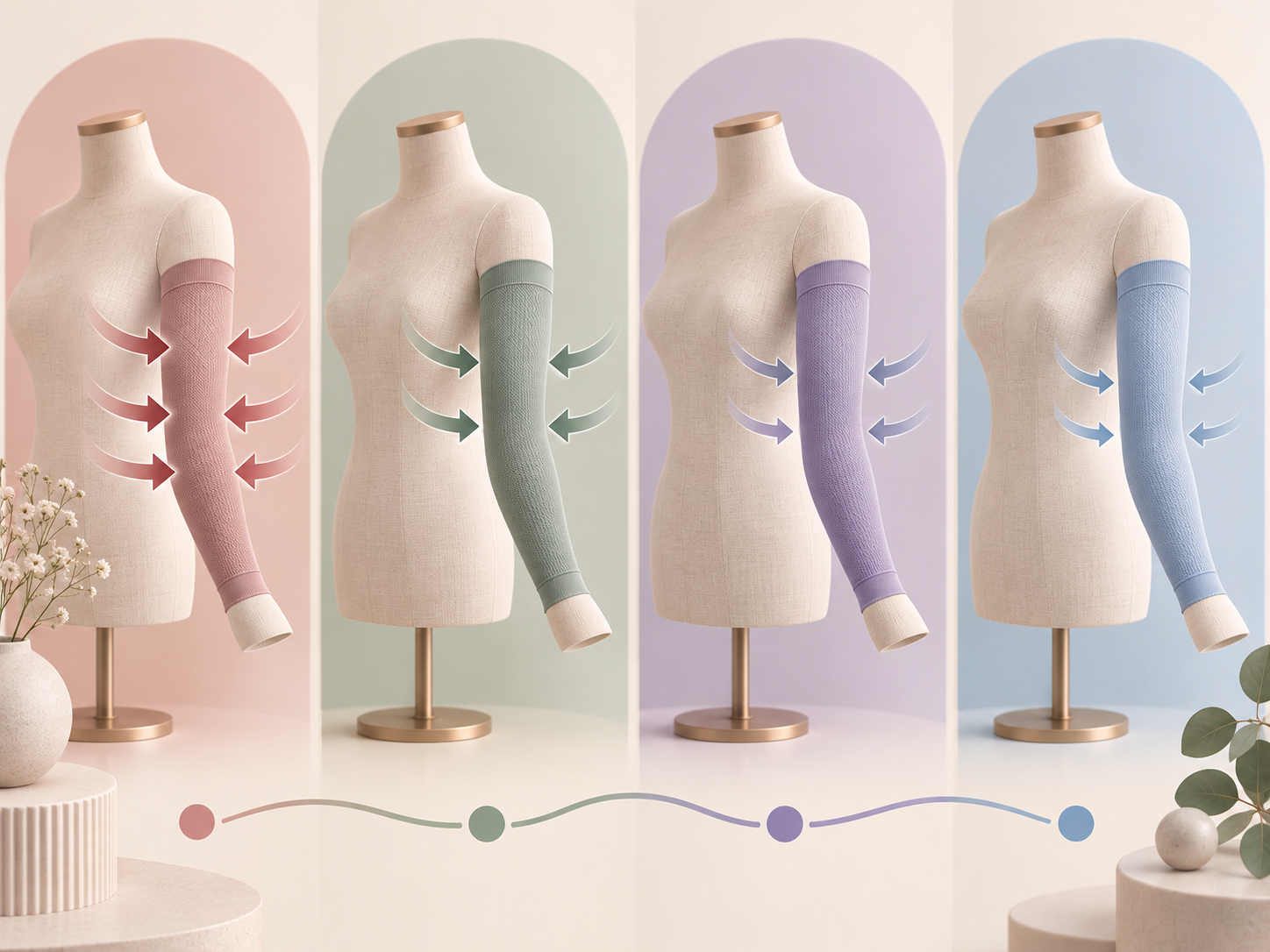
Clear up one misconception first. A compression garment is not a shaping device.
Removing fat leaves a space. Compression reduces that space so the tissue can reattach, and it keeps swelling from pooling in one place. It is a device for stabilizing recovery, not something that makes you thinner the tighter you pull it.
So sizing down on the theory that tighter is better is not something we recommend. Overtightening actually impedes circulation and can leave pressure marks. What matters about compression is that it sits evenly, not that it presses hard.
On the other hand, inconsistent wear can affect how evenly the surface settles. Summer is where wear most often slips, and that is where the disappointment comes from.
It is not 24 hours a day from start to finish
Each stage has a different purpose. The following describes a common course; actual durations follow your clinic’s instructions.
| Stage | What it does | Typical wear | What is hard about it |
|---|---|---|---|
| Surgery to 1 week | Controls early swelling, reduces the space | Nearly all day | Raising the arm is awkward |
| 1 to 2 weeks | Around suture removal, stabilizes the sites | Close to all day | Washing is a nuisance |
| 2 to 4 weeks | Swelling drops and it loosens | Mainly daytime | Sweat and itching |
| 1 to 2 months | The surface is settling | During waking hours | It shows through clothes |
| After 2 months | Maintenance | Adjusted per instructions | You forget and stop wearing it |
The top two stages matter most. This is when the space closes and the layers reattach, so wear that wavers here is hard to make up for later. Further down, there is more room to adjust.
As swelling comes down the garment loosens. Something that fit snugly at first is slack by around week three — that is normal. Rather than sizing down because it loosened, look first at adjusting wearing hours.
Arm compression is usually a vest-style garment, so it feels different from an abdominal one. It covers the shoulders and torso as well, which in summer means heat proportional to the coverage. This is far and away the most common complaint.
Three things that are genuinely hard in summer
These are more practical problems than the duration.
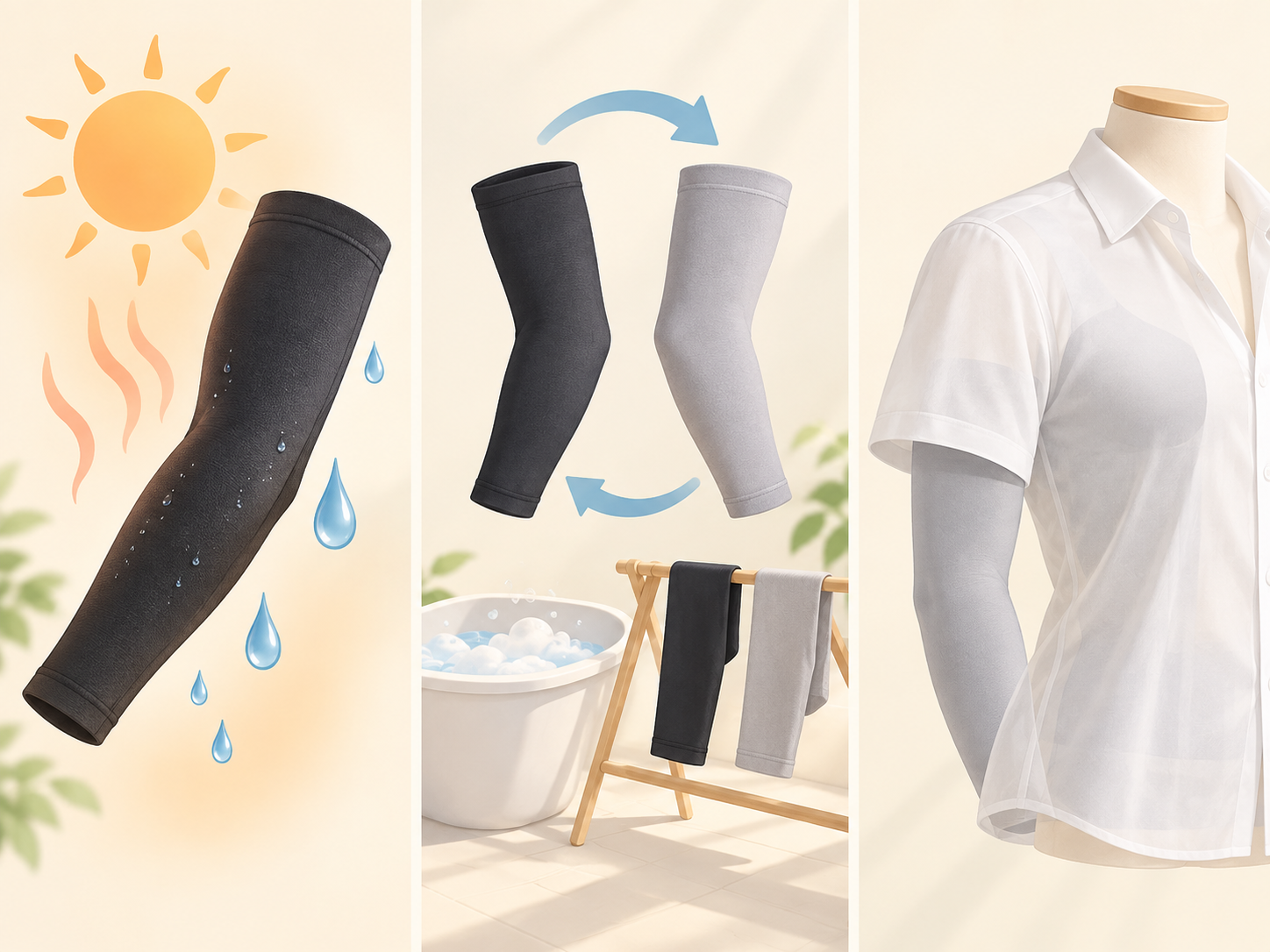
First, sweat. Moisture trapped inside the garment leads to itching or a rash in some cases. And then people cut their own wearing hours. A thin cotton layer underneath keeps the damp off the skin, and on heavy-sweat days it is better to change.
Second, laundry. You wear it every day, and with only one there is no time to dry it — especially in summer. We recommend alternating between two. Hand-wash in lukewarm water and dry in the shade and the elastic lasts far longer. Skip the dryer.
Third, visibility through clothing. Being vest-style, the hem and shoulder lines can show. Thin, fitted tops get avoided during this period; loose cotton tees and button-downs are easier. If you are going into an office, plan this out in advance.
The gap between indoor and outdoor temperature also shifts how it feels across a single day. Hot outside and heavily air-conditioned inside means the garment feels different by the hour. A light layer solves it if you can adjust; a job that keeps you outdoors all day is a real burden. Rather than picking your timing by season alone, look at where you actually spend your day.
Small things in how you wear it
A few points change how the same duration feels.
Smooth out the wrinkles as you put it on. A fold pressed in for hours can leave a line, and the compression is no longer even. Run a hand over it once after dressing.
Raising your arm is awkward early on — washing your hair or changing clothes especially. A front-fastening design makes this much easier, so ask in advance whether you have a choice of style.
Decide how you will sleep in the first days too. You will be wearing it overnight at first, and finding a position where the arm is not pressed takes some trial. Many people find propping a pillow alongside to float the arm slightly makes a real difference.
If itching starts, do not scratch — tell us. Scratching accumulates irritation, and near an incision it affects healing. Changing the material or adding a layer underneath resolves it in most cases.
What happens if I skip it?
Honestly: a day or two of less wear does not overturn the result. We say that first because people sometimes miss once and then give up on the garment entirely.
What causes problems is repeated gaps during the early stages. When the space is closing and the layers are reattaching, inconsistent compression can let swelling pool on one side or leave the surface settling unevenly. Taking it off for days at a time because of summer itching falls into this category.
So if you cannot stand it, do not endure it — tell us. Wearing it over a rash creates a separate skin problem. Changing the material or adjusting how it is worn are both options, and either beats suffering through it alone.
Some clinics use no compression at all. That is not a wrong approach; just be aware that either way, it comes as a set with that clinic’s recovery plan. Follow the instructions from where you had surgery.
How the body moves through each stage is set out in how long swelling lasts after liposuction.
Summer considerations beyond the garment
Since some people pick their timing on the garment alone, here is the rest.
Bruising often bothers people more. Incision marks are small and hard to see from a distance; bruising spreads broadly along the treated area. Treat the whole arm and color reaches below the armpit, darkening between a few days and a week after surgery. Short sleeves will not cover that window.
Ultraviolet light is the other summer variable. Direct sun on healing incision sites in the first few months can leave darker pigmentation. Clothing or sunscreen handles it — but adding a layer over the compression garment is hotter still. That is the real summer burden.
A sweaty environment also complicates incision care. Staying damp for long stretches is not good for healing, so check whether you are in a position to dry off and change regularly. There is individual variation, but with those conditions met, summer is not especially disadvantageous.
How to decide whether to do it in summer
People ask whether the garment alone is reason enough to postpone.
What the season changes is not the result but the conditions you recover in. Surgery in summer does not produce a worse outcome. It is simply more of a nuisance to get through those weeks.
So frame it this way. The criterion is whether you are in a position to keep the compression on consistently. If you spend most of your time indoors, can rotate two garments, and can cover up with clothing, summer is fine. If you sweat all day in your work, cooler weather is easier.
If a date is already fixed, it is faster to count backward from it. Look at how the dark-bruise window and the compression period overlap your calendar.
The duration and strength of compression depend on the area treated and how recovery goes. That is why, when the surgical scope is set at Line Culture Clinic, we set out the compression plan alongside it — in summer that burden is genuinely different. If wearing it becomes too much, do not push through it; contact us and we will find a way to adjust.