Arm Liposuction Before a Wedding: How Close to the Day Is Possible?
Many people start searching the evening after a dress fitting. They say they had no idea their arms would look like that in the mirror.
Search and most answers say two to three months before the ceremony is best. That is true enough, but it is no answer to someone with fifty days left. And for a bride-to-be, there is never only one date.
Should you count from the wedding date?
Scheduling only becomes meaningful once the condition of your arm is established. Reverse the order and you get a plan strained to fit a date.
If yours is an arm where fat comes up thick, liposuction has a real margin of change, and seeing that margin takes time. Conversely, if it comes up thin when pinched yet sways when you raise it, removing fat may not be the answer. In that case the plan changes regardless of the date.
Whether your weight is still moving matters too. Many people diet while preparing for a wedding, and if weight loss is ongoing, the thickness you can pinch now is not final. When weight loss and surgery overlap, there is no telling which produced the result.
If we are ordering them, weight loss comes first. Getting near your target weight and then assessing what remains makes for a more accurate plan. When the wedding timeline is tight you end up doing both at once, and then it is better not to accelerate the loss. Rapid loss means the skin does not tighten in step with the lost volume, so you pass through a period when the arm actually looks looser. Having that period coincide with the shoot is a problem.

A wedding has more than one date
A bride-to-be has at least three dates, and the earliest of them is the reference.
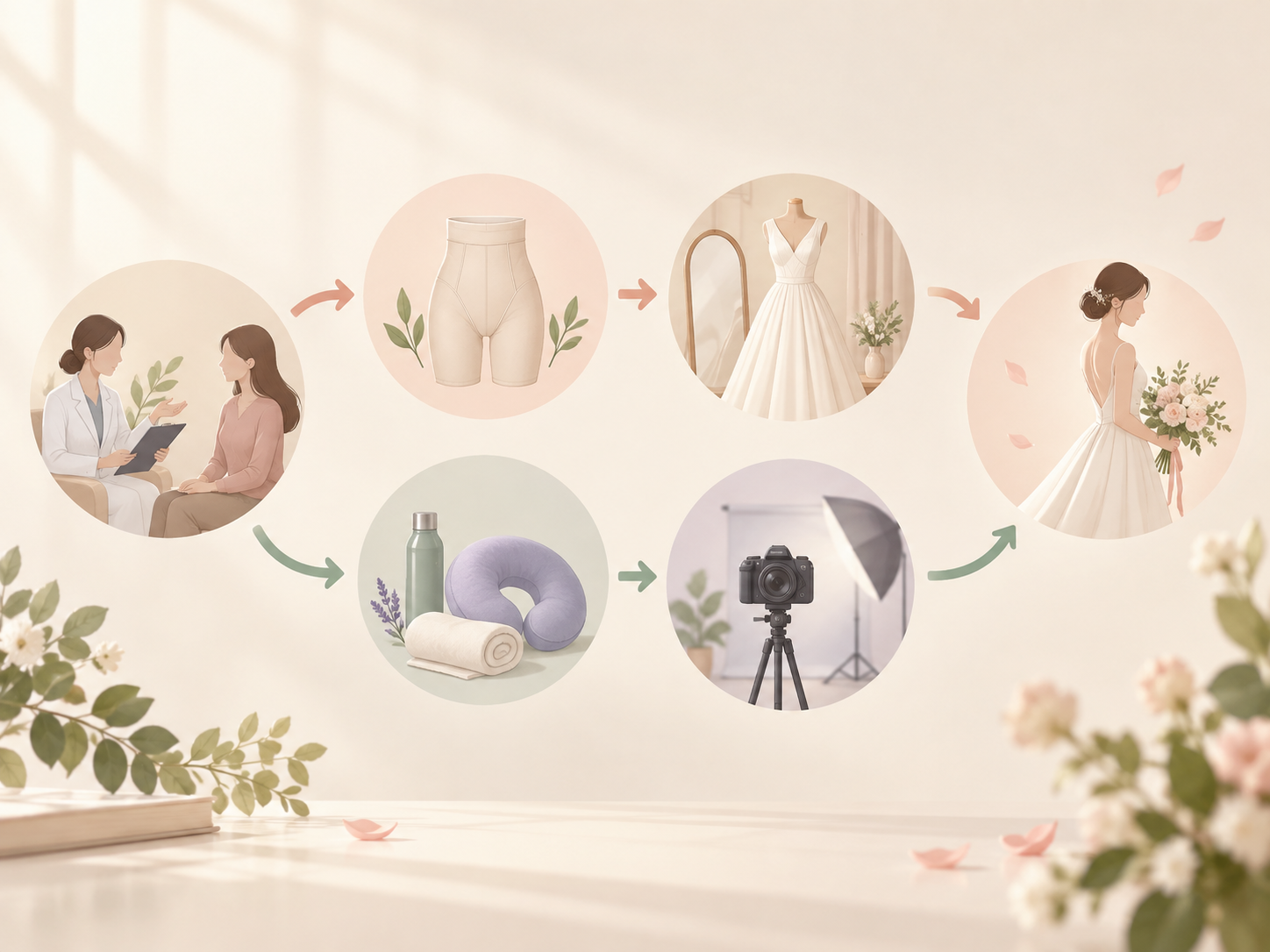
The dress fitting comes first. Here you try on several gowns with your arms bare, and the dress you choose carries through to the ceremony. Next is the studio shoot. A shoot has fixed lighting and angles, making it the setting where the arms show most distinctly. Last is the ceremony itself.
Many people calculate from the ceremony alone. But shoots commonly fall two or three months ahead of it, so planning around the ceremony leaves you still recovering on the day of the shoot. And the photographs remain.
So in consultation we ask for the dates one by one. When is the fitting, when is the shoot, when is the ceremony. We decide which of the three to meet, and only then start counting backward.

What is possible at 90, 60, and 45 days out
The choice differs by time remaining. The table below is based on a common course, and individual variation applies.
| Time remaining | What is possible now | Expected state on the day |
|---|---|---|
| 90 days or more | Plan without restricting the area | Swelling resolved; fit and silhouette both settled |
| 60 to 90 days | Possible as planned | Fit settled; the raised-arm view still resolving |
| 45 to 60 days | Possible, but shoot angles need consideration | Some residual swelling; the lowered-arm view is resolved |
| 30 to 45 days | Judge carefully | Bruising resolved; swelling remains |
| Under 30 days | Surgery not recommended | Bruising and swelling show in photographs |
The fork in the table is 45 days. Below that, the point at which bruising resolves closes in on the event and coverage becomes necessary. Under 30 days, what you must accept on the day outweighs what surgery gains you.
How fast swelling clears differs from person to person and also with the treated area. Treat a wide area and each stage shifts later. So read the numbers in the table as a starting point for planning. We cannot promise they will hold. How the body progresses stage by stage is set out on the Post-Surgery Care page.
Different dress shapes mean different zones to assess
For the same arm, what you need to attend to changes with the dress you wear.
| Dress shape | Exposed zone | What to assess alongside |
|---|---|---|
| Off-the-shoulder | The whole arm; the shoulder junction | The front fold of the armpit |
| Open back | Upper back; the bra line | The line from the back of the arm into the back |
| Sleeved | Lower upper arm; the wrist | The thickest point where the sleeve catches |
| Halter neck | Inner arm; the armpit | Accessory breast prominence |
Zones get missed when you look at the arm alone. Wear an open-back dress but end the treatment at the arm, and the arm is tidied while the line seen from behind stays as it was. Conversely, with a sleeved shape, the single point where the sleeve catches matters more than the whole arm.

So bringing a photo of the dress to your consultation moves things along. Telling us which poses you will be photographed in most helps too.
Incision placement also gains a consideration from the dress. Arm liposuction entry points are openings a few millimeters wide, placed along the inner arm or the crease of the armpit. With the arm lowered they fold away or stay hidden, so they are not readily visible day to day, but if your shoot involves many poses with the arms raised high, it is better to check those spots in advance. How long redness remains differs from person to person and generally runs several months.
Holding a bouquet also creates an angle that exposes the arm. Pressing the arm against the body widens the flattened flesh seen from the side, while lifting it slightly makes that area look tidier. This is worth knowing for the shoot independently of any surgery.
What to consider with under 45 days
With fewer than 45 days, liposuction is a stretch. That does not mean nothing can be done.
If the fat is concentrated narrowly in one or two spots, injection-based methods enter the picture. That term covers approaches that introduce a drug or draw fat out through a fine cannula, without an incision. With no incision or compression burden, the effect on your schedule is small. Because they assume multiple sessions, though, with a fixed date you first have to calculate how many sessions fit in the time left. How injections act is covered on the Fat Dissolving Injection page.
With even less time, adjusting on the dress side remains. Covering with sleeves or a bolero is one approach, and setting shoot angles so the arms show less is another. The arm reads differently in thickness depending on the viewing angle.
And you can put the time after the ceremony into your plan. The arm is not a part you use for one wedding day. Pushing the schedule back gives a better result than cutting the treatment area short to force a fit.
If you shrink the area to meet a date
One last point. The common compromise when a date is tight is to shrink the treated area — do the arm only, since recovery will be faster.
That is an inverted judgment. The arm is a line running into the armpit and the bra line, so cutting the area short to meet a date can leave the arm and what sits beside it reading as two different thicknesses. The arm becomes slimmer while the impression in the dress does not change as much as hoped.
How much faster recovery gets from a smaller area is also less than you would think. How long swelling takes to clear is governed more by individual conditions than by area. You end up trading the result for a few days.
Some people also push aftercare too hard to pull the schedule forward. Massage or radiofrequency treatments applied strongly at an early stage can act as irritation and increase swelling instead. Aftercare has a set starting point and intensity, and moving that point earlier does not move recovery earlier.
Once you have a date, count backward from it, and if that puts you under 45 days, look at the other options instead. With 60 days or more, we recommend not shrinking the area and instead including the zones that ought to be assessed.
Tell us your fitting, shoot, and ceremony dates and we will settle together which one to work from. Bring a photo of the dress and the zones to assess narrow down on the spot. However much time is left, it is worth confirming now whether your arm is a fat problem or an elasticity problem. The tighter your date, the sooner you should get in touch.