Arm Liposuction Checklist: Why the Arm Is Never Assessed Alone

People looking into arm liposuction usually describe the same things: flesh spreading sideways when the arm is down, hanging down when the arm is raised, and the line that shows in a sleeveless or fitted top. When the weight comes off everywhere except the upper arm, surgery starts to enter the picture.
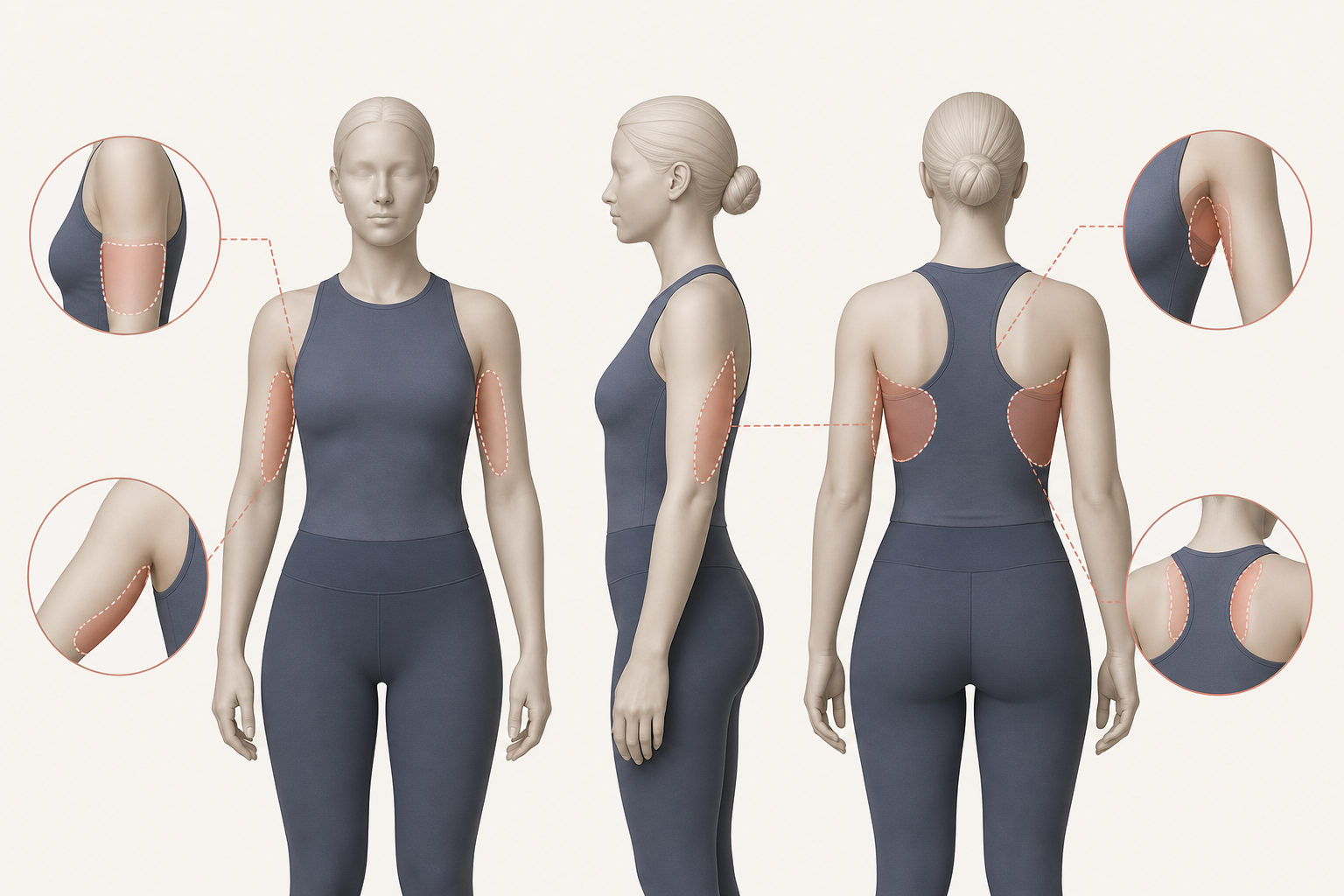
But the upper arm is not simply “somewhere you remove the fat on the inside.” The back of the arm, the armpit, accessory breast tissue, the bra line, and the thickness of the upper body carrying into the shoulder all read together — so how far the design reaches changes the before-and-after entirely.
What matters is not removing a lot but reducing evenly, keeping the skin surface smooth, and placing scars where they draw least attention. We do not look at the arm from the front alone; we check the connection with the arm lowered, raised, and held against the body.
How far should the assessment reach?
The result is not decided by the inner arm. An arm reads as thick because fat at the back of the arm, folds at the front and rear of the armpit, accessory breast tissue, and thickness around the bra line are all visible at once.
So a pre-consultation checklist should be built less around whether circumference will drop and more around whether the borders between arm and armpit, and arm and torso, can carry naturally. Reduce one part alone and the surrounding area can stand out more.
| Area | What to check | What the consultation establishes |
|---|---|---|
| Back of the arm | Thickness spreading sideways with the arm down | Separating fat layer from muscle projection |
| Inner arm | What hangs down when the arm is raised | Skin elasticity and the degree of laxity |
| Armpit and accessory breast tissue | What protrudes beside a sleeveless top or a bra | Whether it belongs in the same scope |
| Bra line | The junction that makes the upper body read thick | Design carrying into the torso line |
Arm liposuction is less about thinning the arm than about resolving the line where arm and upper body meet. So the first thing to settle in consultation is whether the arm is being assessed alone, or alongside the armpit and accessory breast tissue.
When does it suit?
Building muscle in the arm while the fat layer remains can make it look thicker, not slimmer. If you are slim everywhere but the upper arm, or the flesh underneath moves when you shake the arm, the fat layer is worth examining.
That said, looking thick does not make every arm a candidate. A developed muscle, substantial skin laxity, or being immediately post-weight-change all alter what is realistic.
| Your current state | What to look at first | Why |
|---|---|---|
| Fat at the back of the arm pinches thick | Consider liposuction | Subcutaneous fat may be the main driver |
| The skin on the inner arm has stretched | Establish how laxity will be handled | Reducing fat alone leaves skin behind |
| The armpit and accessory tissue protrude too | Design the junction | Treating the arm alone leaves the side line |
| The arm muscle is developed and firm | Check the fat layer first | Liposuction cannot reduce muscle thickness |
Why skin and structure are assessed together
The skin on the arm is relatively thin, and nerves, vessels, and lymphatics run close. So while it looks like a small area, it calls for a careful approach. Fat that is not reduced evenly shows up as unevenness, dents, asymmetry, and skin laxity.
The inner arm in particular means weighing scarring and laxity at once. Plan on volume alone and the surface may not settle smoothly, or the skin may not follow. Go too conservative and the change feels insufficient.
| What worries people | Why it can happen | What to confirm beforehand |
|---|---|---|
| Unevenness | Uneven removal, firmness during healing | Fat layer thickness and surface elasticity |
| Skin laxity | Low elasticity, weight change, over-removal | How much hangs when the arm is raised |
| Scarring | Incision placement, skin type, aftercare | Whether a hidden site such as the armpit works |
| Changes in sensation | Nerve irritation, swelling, tissue healing | Any existing tingling or altered sensation |
The considerations that apply across all areas are covered in minimizing liposuction scars.
Recovery depends on how much you use your arms
Arms work all day. Dressing, washing your hair, carrying a bag, typing — small movements repeat constantly, so swelling, firmness, and tightness are felt more readily here.
Early on there is bruising, swelling, and pressure; even after the major swelling drops, firm areas and a pulling sensation can remain. Rather than concluding the line has not come out, photograph the same angle and follow the course.
| Stage | What you may feel | What to manage |
|---|---|---|
| First week | Bruising, swelling, tightness, awkward movement | Avoid heavy lifting and overusing the arm |
| 2 to 4 weeks | Major swelling eases; the line starts to move | Compression garment and follow-up visits |
| 1 to 3 months | Firmness and tightness gradually ease | Review symmetry and skin elasticity |
| 3 to 6 months | The line settles | Close enough to treat as the final result |
Recovery timelines vary widely. The stage-by-stage course is set out in how long swelling lasts after liposuction.
We read the arm as a line, all the way around
In consultation we do not look at a single point on the inner arm. We look at the side line with the arm down, the hang with it raised, and the flow through the armpit, accessory breast tissue, and bra line into the upper body.
Ultrasound, photographic review, and a pinch test establish the fat layer and skin elasticity, and we plan incision placement along with compression and the aftercare schedule. On the arm, reducing evenly and smoothing the junction matters more than removing a lot.
Look at the connection, not the area
To sum up: arm liposuction is not a question of the fat on the inner arm. The back of the arm, the armpit, accessory breast tissue, and the bra line have to be read as one upper-body line before the change looks natural.
Before your consultation, think beyond how much circumference will come off — incision placement, surface smoothness, skin laxity, the junction with accessory tissue, and the recovery process all belong in the conversation. Results, bruising, swelling, firmness, scarring, changes in sensation, and recovery time vary from person to person.
At Line Culture Clinic, in a private space near Exit 3 of Apgujeong Station, we establish your current arm line first and then discuss the scope and the recovery plan. You are welcome to get in touch.