Lumpiness After Liposuction: Healing, or Something to Check?
Feeling unevenness after liposuction makes it easy to worry that something went wrong. A firm lump under your fingers, or a surface that does not look smooth in the mirror, immediately raises the question: is this part of healing, or is it a complication?
In the weeks right after surgery, unevenness is usually swelling, bruising, tissue healing, and fibrosis all showing at once. Conversely, if enough time has passed and a specific area is hollowed, pulls strongly, or shows a distinct difference in surface, the course needs reviewing.
This article separates the signals rather than jumping to a conclusion — including the firmness that appears during healing, which in Korea is commonly called biobond.
Why does unevenness happen?
Liposuction draws fat from the subcutaneous layer beneath the skin through a cannula. In the process, tissue is disturbed, and the body forms fibrous tissue to repair it. That creates a period where the area feels firm or uneven to the touch.
The Korean term biobond refers to the firm, knotted, or tight feeling during post-operative healing. Medically it relates to a fibrotic response, and it often appears early and eases over time.
| Cause | How it feels | What to check |
|---|---|---|
| Swelling | The area feels full and heavy | Whether it varies with time of day and activity |
| Fibrosis (biobond) | A hard band, knotted feeling, tightness | Whether it eases across three to six months |
| Adhesion | Skin pulling as if bound to a deeper layer | Whether a spot drags when you move |
| Hollowing or uneven removal | One area looks depressed | Whether the border stays distinct after swelling goes |
Early unevenness is often part of healing, but not every case resolves on its own. Timing, shape, pain, and how much it pulls all have to be read together.
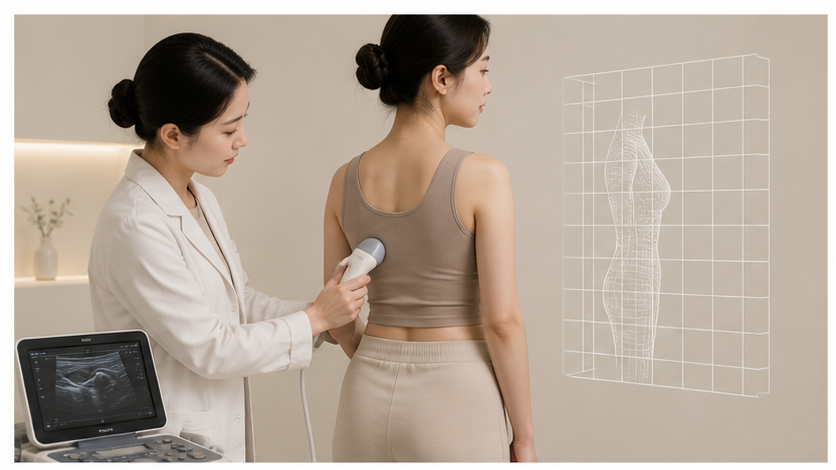
Healing, or something that needs checking?
What matters is whether there is a trend toward softening. Even if it feels firm and knotted, if the area is shrinking and the tightness is easing, it can be followed as part of healing.
Conversely, if a specific area looks deeply hollowed, if asymmetry is becoming more pronounced, or if pain and heat accompany it, that is harder to read as simple healing. Rather than trying to massage it out yourself, have the course reviewed where you had the surgery.
| Your current state | What it may be | What to do |
|---|---|---|
| Firm lumps within one to two months | Possibly part of healing | Follow the course and the instructions you were given |
| Gradually softening between three and six months | A normal healing trend | Keep photographic records and continue aftercare |
| One area looks deeply hollowed | Possible hollowing | Review it once the swelling has gone |
| Heat, significant pain, redness | Inflammation needs ruling out | Contact the clinic promptly |
It reads differently by area
Unevenness is felt differently depending on where it is. The upper arm, with thin skin and constant movement, shows surface texture readily. The inner thigh and the area above the knee make hollowing and borders obvious. On the abdomen, how it folds when you sit or lean forward can make firmness feel more pronounced.
So the same unevenness is read differently depending on the area treated, skin elasticity, the extent of the surgery, and the stage of recovery.
| Area | What tends to show | How to check |
|---|---|---|
| Upper arm | Surface texture, tightness, discomfort in use | Look with the arm both raised and lowered |
| Thigh | Hollowing on the inner side, a border above the knee | Compare standing still and walking |
| Abdomen | Folding when seated, firmness at the flanks | Check front, side, and seated |
| Face | Firmness under the chin, tightness in the lower face | Check from the side and below rather than the front |
When is treatment actually needed?
Post-operative treatment is less a way to erase unevenness immediately than a way to support the process of swelling and firmness resolving, while following the course. Radiofrequency, endermologie, and shockwave can all be chosen according to the state of things — but more sessions is not automatically better.
What matters is separating swelling from fibrosis from adhesion first. Repeating strong massage or self-directed care without establishing the cause tends to increase pain and irritation rather than reduce them.
| Ask before starting treatment | Why it matters |
|---|---|
| Is this stage within the common range? | Avoids judging too early |
| Is the firmness trending downward? | Separates healing from adhesion |
| Does this state call for strong massage? | Avoids unnecessary irritation |
| When can a revision be considered? | Avoids deciding before recovery finishes |
If the recovery timeline is what you want to understand, read how long swelling lasts after liposuction alongside this.
Read the timing and the shape together
Unevenness after liposuction can come from swelling, fibrosis, adhesion, hollowing, or uneven removal. Early firmness is often part of healing, but deep depressions or strong pulling that persist over time call for review.
Before aggressive self-massage or a quick decision about revision, establish exactly where you are in the course and what the state actually is. Results, bruising, swelling, firmness, scarring, changes in sensation, and recovery time all vary from person to person.
At Line Culture Clinic, in a private space near Exit 3 of Apgujeong Station, we establish your current line first and then discuss what is needed. If you cannot tell whether what you are feeling is a common course or something to check, get in touch.