Neck Hump: Can a Procedure Actually Fix It?
When the lower part of the back of the neck rounds and rises, the profile reads as heavy and the neck looks short. In photographs the border between neck and shoulders is not smooth, and from behind it can look like a small hump below the neck.
In English this is usually just a neck hump — sometimes called a buffalo hump. It is a familiar concern for anyone who spends long hours on a phone or laptop.
Before looking for ways to correct it, there is something worth knowing. This may not be a problem with the flesh at the back of the neck at all. More often it is forward head posture, a rounded upper back, the alignment of the cervical and thoracic spine, the thickness of the tissue there, and the skin and fat layer, all showing at once.
This article covers why it develops, how to approach posture and exercise, and what a procedure can and cannot change.
What exactly is it?
It describes a state where the lower neck — specifically where the neck meets the upper back — projects in a rounded shape. It is a description of appearance rather than a formal diagnosis.
The area around the seventh cervical vertebra is palpable in most people to some degree. It becomes a concern when these changes appear together.
- The neck looks as though it sits forward
- The upper back is rounded
- The lower back of the neck looks thick, like a hump
- The neck and shoulders are often stiff
- The neck looks short and the face appears to sit forward
- The jawline and double chin look blurred with it
Why does it develop?
The largest factor is posture repeated over years — particularly a head carried forward combined with rounded shoulders and a rounded upper back.
The head is heavier than people assume. The further it sits in front of the body’s midline, the greater the load on the lower neck. Repeated over time, the muscles and ligaments at the back of the neck tighten, and the upper back gradually stiffens into a rounder shape.
Not every neck hump comes from posture, though. Less commonly, an endocrine condition such as Cushing’s syndrome, a fracture or spinal condition, medication effects, or rapid weight change can be involved. If the hump has grown suddenly, or there is pain, tingling, or altered sensation, medical assessment comes before any cosmetic procedure.
Check where you stand
| What you notice | Direction to consider |
|---|---|
| In a profile photo the ear sits ahead of the shoulder | Forward head posture |
| The area between neck and back rises in a rounded shape | Likely a neck hump |
| Shoulders roll forward and the back is rounded | Rounded shoulders and upper back |
| Tucking the chin makes the back of the neck feel tight | Muscle tension at the back of the neck |
| The back of the neck has soft thickness to the touch | Possible fat layer |
| It feels hard, like protruding bone | Spinal alignment needs checking |
| There is arm or hand tingling, or headaches | Seek medical assessment first |
Posture and muscle are the core of it
The foundation is posture. If the projection comes from head position and a rounded upper back, reducing fat or loosening it with massage tends not to hold.
Correction generally works in four directions.
First, release what is tight. When the suboccipital muscles at the base of the skull, the sternocleidomastoid at the front of the neck, and the muscles across the chest are tight, the head sits forward more easily.
Second, restore movement in a stiff neck and upper back. When the cervical and thoracic spine are stiff, tucking the chin and lifting the chest becomes awkward to hold.
Third, strengthen the deep neck flexors. These hold the chin gently tucked; when they are weak, the head drifts forward again.
Fourth, address rounded shoulders and upper back together. Pulling the neck back alone will not hold if the back stays rounded.
Habits you can build at home
- Hold your phone near eye level rather than below your chest
- Use a stand and an external keyboard with a laptop
- Set the monitor so your head is not tipped far down
- Stand up every 30 to 50 minutes and move the neck and back
- Build the habit of tucking the chin gently rather than pushing it forward
- Cut back on high pillows and sleeping face down
- Combine chest stretches with strengthening for the back
Can a procedure correct it?
Directly: a procedure cannot correct posture itself. Spinal alignment, muscle weakness, and rounded shoulders belong to exercise, daily habits, and where necessary specialist treatment.
But where the thickness you see at the back of the neck relates to a fat layer or to skin elasticity, that part can be discussed as a supporting measure.
For example:
- There is a soft, pinchable fat layer at the lower back of the neck
- A double chin and the line of the neck read as blurred together
- Skin elasticity has declined across the lower face and front of the neck
- Fluid and fat are mixed, blurring the border between neck and jaw
- You are already working on posture and the neck and jawline still read as heavy
Related: injectable fat reduction
When medical assessment comes first
If any of the following apply, see an orthopedic, rehabilitation, or neurosurgical specialist first.
- The hump has grown suddenly
- Neck pain is severe, or wakes you at night
- There is tingling in the arm or hand, or reduced sensation
- Headache, dizziness, or visual disturbance accompanies it
- It appeared after an injury
- Steroid use or an endocrine condition is a possibility
- It feels like a hard mass and does not move
The injectable treatments, lifting, and facial liposuction we offer are options for refining how a line looks. They are not treatment for pain conditions, nerve symptoms, or problems with spinal alignment.
In short: posture is the foundation
Posture and muscle are the core. Head position, a rounded back, rounded shoulders, and weakened deep neck flexors have to be addressed together, and stretching and strengthening have to be ongoing.
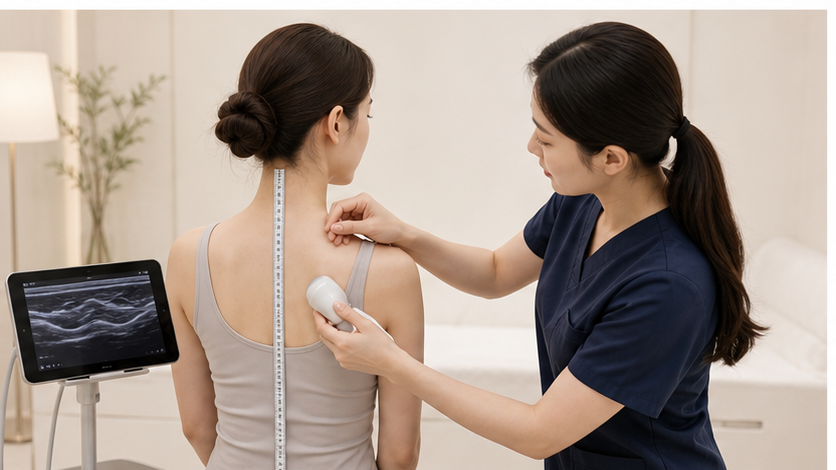
A procedure will not change posture. But where a fat layer, skin elasticity, and a double chin are contributing to how heavy the neck and jawline read, we can discuss supporting options after confirming what is there with ultrasound.
At Line Culture Clinic, in a private space near Exit 3 of Apgujeong Station, we confirm the facial fat layers and skin condition and discuss which direction is actually needed.
Results, recovery time, swelling, bruising, scarring, pigmentation, and discomfort all vary from person to person. If pain or tingling is involved, get it assessed medically first; for how the neck and jawline look, establish your current state before deciding. Bring a profile and a rear photograph and we can narrow it down on the spot.