How to Get Rid of a Double Chin: Find Your Type First
Your weight has not changed much, and yet in photographs the area under the chin looks unusually thick. Tilt your head down slightly and it folds; from the side, the border between neck and chin blurs.
It is easy to assume a double chin simply means weight gain, but the causes are more varied than that. Sometimes it is fat. Sometimes it is skin that has lost elasticity. Forward head posture, fluid retention, enlarged salivary glands, and jaw structure can all be involved.
So the decision should not start at “liposuction or injections.” Establish which type you have first, and the direction that holds up over time becomes clear.
Why does a double chin form?
It describes a state where fat or skin layers under the chin blur the border between neck and jaw. It does not only happen to people carrying extra weight — some people are slim and still have it, and some lose weight and find it unchanged.
The common causes divide roughly like this.
- A thick layer of subcutaneous fat under the chin
- Reduced skin elasticity, letting fat and skin descend
- Forward head posture, a habit of not tucking the chin, high pillows
- Repeated fluid retention from salty food, late meals, and poor sleep
- A recessed or short chin — jaw structure making it more visible
- Enlarged salivary glands making the structures under the chin look bigger
- Less commonly, the muscle under the chin itself having stretched
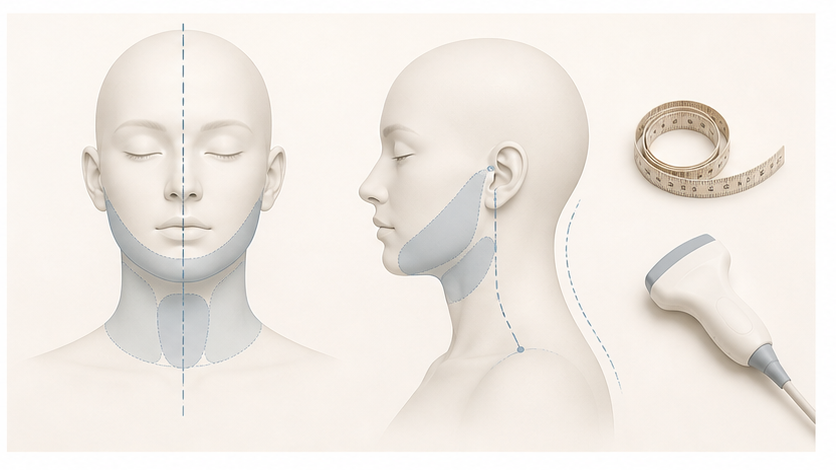
Type 1. Soft and thick to pinch — fat-dominant
If the area under the chin has clear, soft thickness when you pinch it, and the volume is obvious when you look down or from the side, fat is likely the main driver.
This type becomes more prominent with weight gain and often stays put after dieting. Some people are simply predisposed to store fat there; some carry it in the lower face.
Two options are worth considering.
- Injectable fat reduction: suits a thinner fat layer where surgery feels like too much, for a lighter refinement of the line
- Facial liposuction: worth considering where the layer under the chin is clearly present and the jawline is blurred with it
What matters is not how much comes out. The skin under the chin is thin and the line shows immediately, so a fat layer that is not left evenly leads to unevenness, sagging, and an awkward jawline.
Related: facial liposuction
Type 2. Not much fat, but loose — elasticity-dominant
If the fat under the chin is not especially thick but the jawline is blurred and the skin reads as descended, reduced elasticity may be the driver.
This becomes more apparent with age. As the facial fat layers, muscle, and skin support weaken, the tissue under the chin descends and the neck-to-jaw border softens away.
Reducing fat aggressively here can leave the skin looking looser than before. Lifting needs to be part of the plan.
- Thread lifting: repositions tissue against the direction of descent to help define the jawline
- HIFU and radiofrequency: worth considering for tightening skin and soft tissue
- Injectable lifting: a supporting option that addresses fluid, fat, and elasticity together
- Suction combined with lifting: for mixed cases with both fat and weak elasticity
Related: lifting
Type 3. Posture making it look worse
Long stretches looking down at a phone, or a head that habitually sits forward, make a double chin look considerably worse. Forward head posture shortens the neck visually and folds the skin and muscle under the chin, blurring the jawline.
For this type, adjusting daily habits is the core of it.
- Hold your phone closer to eye level
- Set the monitor slightly below eye line, not far below
- Build the habit of tucking the chin gently rather than pushing it forward
- Cut back on high pillows, sleeping face down, and resting your chin on your hand
- Stretch the front of the neck and under the chin consistently
Type 4. Fluid retention and daily habits
If your face swells in the morning and the area under the chin looks thicker after salty food, late meals, or drinking, fluid retention may be the main factor.
Here it is worth adjusting daily habits before deciding on any procedure.
- Reduce late meals and salty food
- Keep sleep times consistent
- Drink less often
- Drink enough water
- Do light cardio and neck stretches
- Encourage circulation gently rather than rubbing hard under the chin
Type 5. Salivary glands or jaw structure
Some cases that look like a double chin are not resolved by liposuction or injections. The two most common are enlarged salivary glands and jaw structure.
When the glands below the ear or under the jaw enlarge, both sides of the neck or the area under the chin can look swollen. Frequent overeating, late meals, drinking, smoking, hard foods, and vomiting are understood to irritate the glands. If both sides under the chin have become prominent suddenly, or you can feel a firm area, do not treat it as a fat problem.
A small or short jawbone also makes a double chin more visible. Even without much fat, a chin that sits back shortens the border between jaw and neck, so there appears to be more flesh there than there is.
Who actually needs the muscle tightened?
Searches turn up procedures that tighten the muscle under the chin. Those are considered when the muscle itself has stretched, separated, or descended. Not every double chin needs it. Where fat and elasticity are the main factors — commonly in people in their twenties and thirties — addressing the fat layer and lifting is often enough.
We start with ultrasound and photographic review to establish the fat layer, skin thickness, and the angle of the jawline. Finding the smallest combination that suits your current state gets closer to a natural contour than adding methods that were never needed.
Choosing, side by side
| What you notice | Likely type | Direction to consider |
|---|---|---|
| Soft and thick to pinch under the chin | Fat-dominant | Facial liposuction, injectable reduction |
| Little fat but a blurred jawline | Elasticity-dominant | Lifting, tightening treatments |
| Noticeably worse when you look down | Posture-driven | Posture work, stretching, procedures alongside if needed |
| Worse in the morning, or after late meals and drinking | Fluid retention | Daily habits, circulation, confirming the cause |
| Both sides under the chin feel firm and prominent | Possible salivary gland | Medical assessment first, then habits |
| The chin looks small and set back | Jaw structure | A consultation about supporting the jaw line |
| The center of the neck looks slack with age | Muscle and skin laxity | Lifting, with muscle tightening considered if indicated |
Each type needs its own approach
There is no single method. A fat-dominant chin may need the layer under it reduced directly; an elasticity-dominant one needs lifting in the plan. Posture, fluid retention, enlarged salivary glands, jaw structure, and muscle laxity can all produce the same appearance.
At Line Culture Clinic, in a private space near Exit 3 of Apgujeong Station, we confirm the facial fat layers and skin condition with ultrasound and discuss which of liposuction, injectable reduction, and lifting is actually called for.
Results, recovery time, swelling, bruising, scarring, pigmentation, and discomfort all vary from person to person. If you cannot tell which type you are, bring a photo looking down and one in profile — it narrows quickly from there.