Lumpiness After Arm Liposuction: When It Appeared Comes First
At some point after surgery you run a hand over your arm, feel that the surface is not even, and start searching. What you find is a tidy list of causes — and after reading it, which one applies to you is still an open question.
That is because the names of the causes do not separate them. The same feeling under your fingers means something entirely different depending on which week after surgery it appeared. So this article is organized by time rather than by cause.
The arm shows its surface more than most areas
Each area has its own circumstances. The arm is one where the surface shows readily.
The fat layer is thin. The abdomen has a thick layer and therefore some margin — take a little more or a little less and the surface absorbs the difference. The arm has much less margin, so a few millimeters show through directly.
The skin is thin too. Contours in the layer beneath are not covered; they read through. The same degree of firmness is easier to feel and easier to see on the arm than on the abdomen.
It is a place that moves constantly. Every time you raise, lower, or bend the arm, the shape of the surface changes. This is the case where things look smooth at rest but contours appear when you lift the arm.
So on the arm, the surface reads more sensitively under the same conditions. Knowing that keeps you from over-interpreting the contours you feel during recovery.
When it appeared tells you what it is
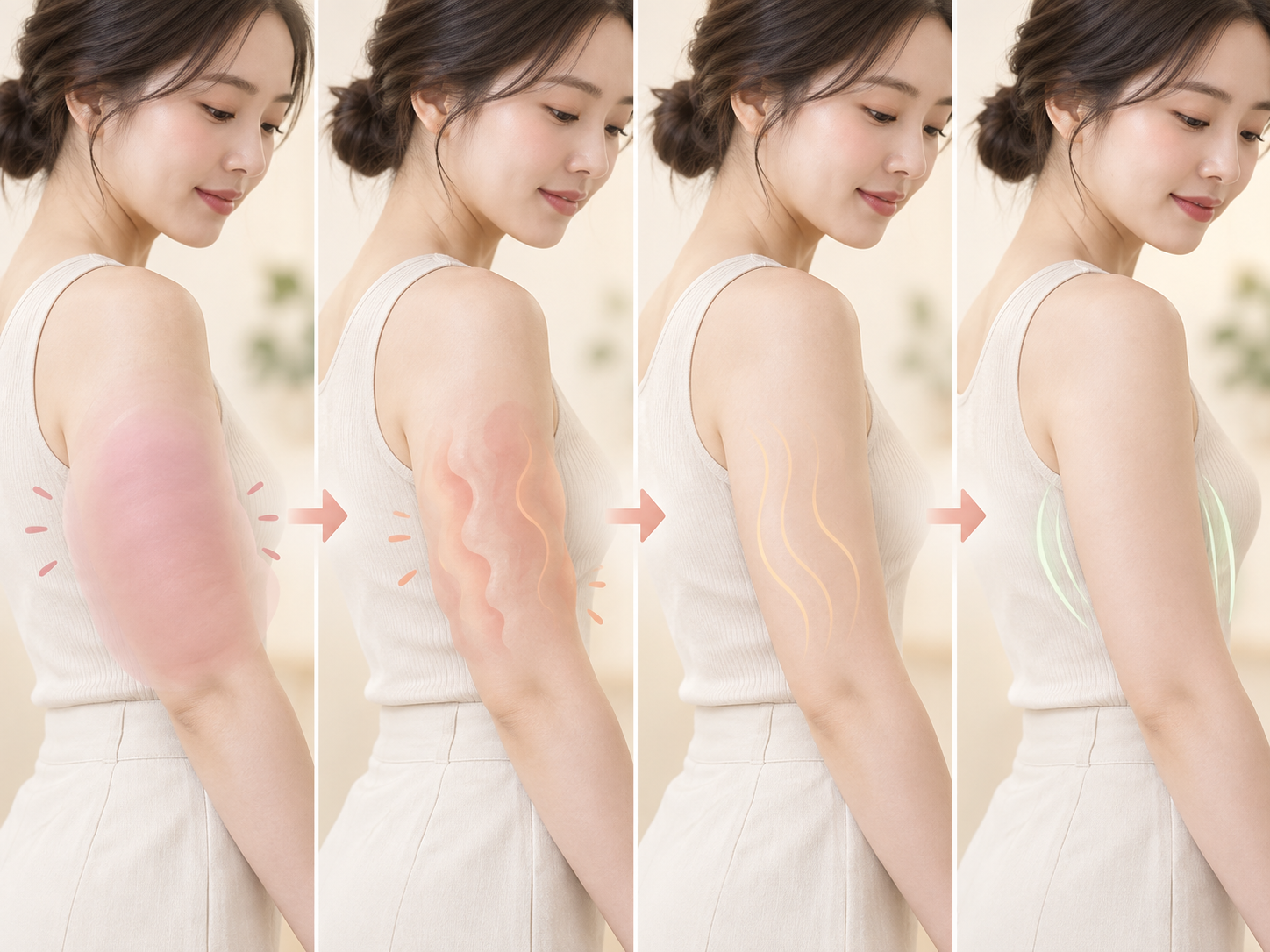
Here is what is common at each stage. These describe a common course; individual results vary.
| Stage | Common cause | How it feels | What usually happens |
|---|---|---|---|
| Surgery to 2 weeks | Swelling sitting unevenly | Soft, edges blurred | Resolves as the swelling goes down |
| 2 weeks to 1 month | Swelling plus early healing | Firms up in patches | Starts softening around one month |
| 1 to 3 months | Tissue firmness | Feels like a lump | Usually releases over 3 to 6 months |
| 3 to 6 months | Firmness persisting, or a layer difference | Same spot, unchanged | A window where checking is warranted |
| After 6 months | A layer difference that remained | Fixed in position | Reviewed together in consultation |
The top three rows are part of recovery. Tissue firming up temporarily as it heals is a common course, not a complication. Many people are alarmed by the lump they feel in this window, but it generally begins softening around the one-month mark and settles over three to six months.
The bottom two rows are a different conversation. When the spot stays put and the size does not change with time, that is when what is still healing needs separating from what has remained.
Wait, or have it looked at?
One standard makes this easy. If it is improving even slightly week to week, you can wait.
Settle on a method for checking, too. Feel the same spot the same way, two weeks apart. Check daily and your eyes and hands adapt, so you miss the gradual change. Photographs in the same place, same light, same position give you something to compare.
A downward direction is a common course. What calls for a message is no change, or the sense that the area is spreading.
Some things warrant telling us immediately, whatever the stage: one side swelling sharply or feeling hot, pain that eased and then worsened again, or an incision site that keeps draining. Those belong to a different branch than surface texture.
Feeling a difference between left and right also comes up often in this window. Very few arms are perfectly symmetrical, so in many cases the original difference — hidden until now by swelling — is simply becoming visible. Whether surgery created it or it was always there becomes clear against pre-op photographs.
The items that apply regardless of body area are covered separately in the post-liposuction lumpiness checklist. This article covers what is different about the arm.
What if it shows when the arm is raised but not lowered?
This case deserves its own heading: smooth at rest, but contours appear when you lift the arm or flex.
On the arm this is common. When the muscle underneath contracts, the layer above is pushed up and the surface shape changes. The fat layer is thin here, so that change reads straight through. Some arms are simply like this, with no surgery involved.
After surgery, though, there is one more thing to consider. Layers sometimes adhere to each other in patches while healing, and an adhered spot does not travel with the movement, so it shows up as a pulling sensation or a line. Most of these release over time.
Time is what separates them. If it was always there, it shows in the same position in your pre-op photographs. That is exactly why we ask you to photograph the arm raised before surgery. If it appeared afterward, watch whether the direction is toward less each week.
Unchanged, or a pulling sensation growing more distinct, is when a check is needed. How the body moves through each stage is set out in how long swelling lasts after liposuction.
Treatments do not move it earlier
Once you feel firmness, you start looking into massage and radiofrequency. Here is the order that matters.
Strong treatment early is not something we recommend. Stimulating a layer that is still healing can increase swelling instead. When treatments start and at what intensity is set, and moving that date earlier does not move recovery earlier.
When to begin is decided as the course unfolds. We will tell you when the time comes. It generally starts once swelling has largely come down and the incision sites have closed, and that point depends on the area treated and how quickly you recover.
Compression, by contrast, matters from the beginning. Removing fat leaves a space, and compression reduces that space so the layers can reattach. It also keeps swelling from pooling in one place. Inconsistent wear can affect how evenly the surface settles. Summer is where people most often let it slip, and that is where the disappointment comes from.
That is as far as you can check on your own during recovery. Fingers tell you how firm something is; what the layer beneath is doing is another matter.
Before surgery, you can reduce the odds
If you are still before surgery, this part is the most useful. Whether the surface comes out even is decided in large part by judgments made during the operation.
Was the thickness to leave behind decided in advance? That is the first. Fat is not only something to remove; it is the layer under the skin that supports the surface. Start without deciding what to leave and the standard becomes “as much as can be taken,” and on an area with as little margin as the arm, that shows on the surface directly.
Which layer is it taken from? That is the second. Fat at the back of the arm divides into a shallow layer and a deep one. The shallow layer sits just under the skin, so taking a lot from there leaves the surface uneven. The same volume produces a different result depending on which layer it came from.
Cutting the scope too narrow also shows on the surface. A step between what was treated and what was left reads as an uneven surface too. Where the scope stops connects directly to the surface question.
Where elasticity is on the lower side, we are conservative. Once the volume that was holding things up is gone, the leftover skin shows, and you can end up thinner but with a surface that draws more attention than before.
So the thing to ask in consultation is not how much will be removed. It is how much thickness will be left on my arm, and which layers are planned. Clinics divide on whether they answer those two against your arm specifically or in generalities.
When the surface does not feel even, the fastest route is having the person who knows your starting state look at it. Someone who knows which layers were treated, what was left, and how much asymmetry you began with can tell immediately whether this is a time to wait or a time to look. That is why at Line Culture Clinic the person who performed the surgery also follows the course. When what you feel with your fingers is not enough to settle it, we will look at the layers and give you an answer.