Arm Liposuction Scars: Exactly Where They End Up
As summer approaches, the question we get most in consultations is about scars. Will they show in short sleeves? Will they be visible when I raise my arm?
Search for the answer and you mostly find “they are placed where they will not be seen.” What is rare is anything telling you where exactly that is. So here is the location, the number, and how it all changes over time, set out separately.
Where is “where they will not be seen”?
Start with size. A liposuction incision is an opening for the cannula, usually a few millimeters across. It is not a continuous line the way a lift incision is.
Location is chosen on two conditions at once: the area the cannula has to reach and the angles you are normally exposed at. The spot where both line up is the one that gets used.
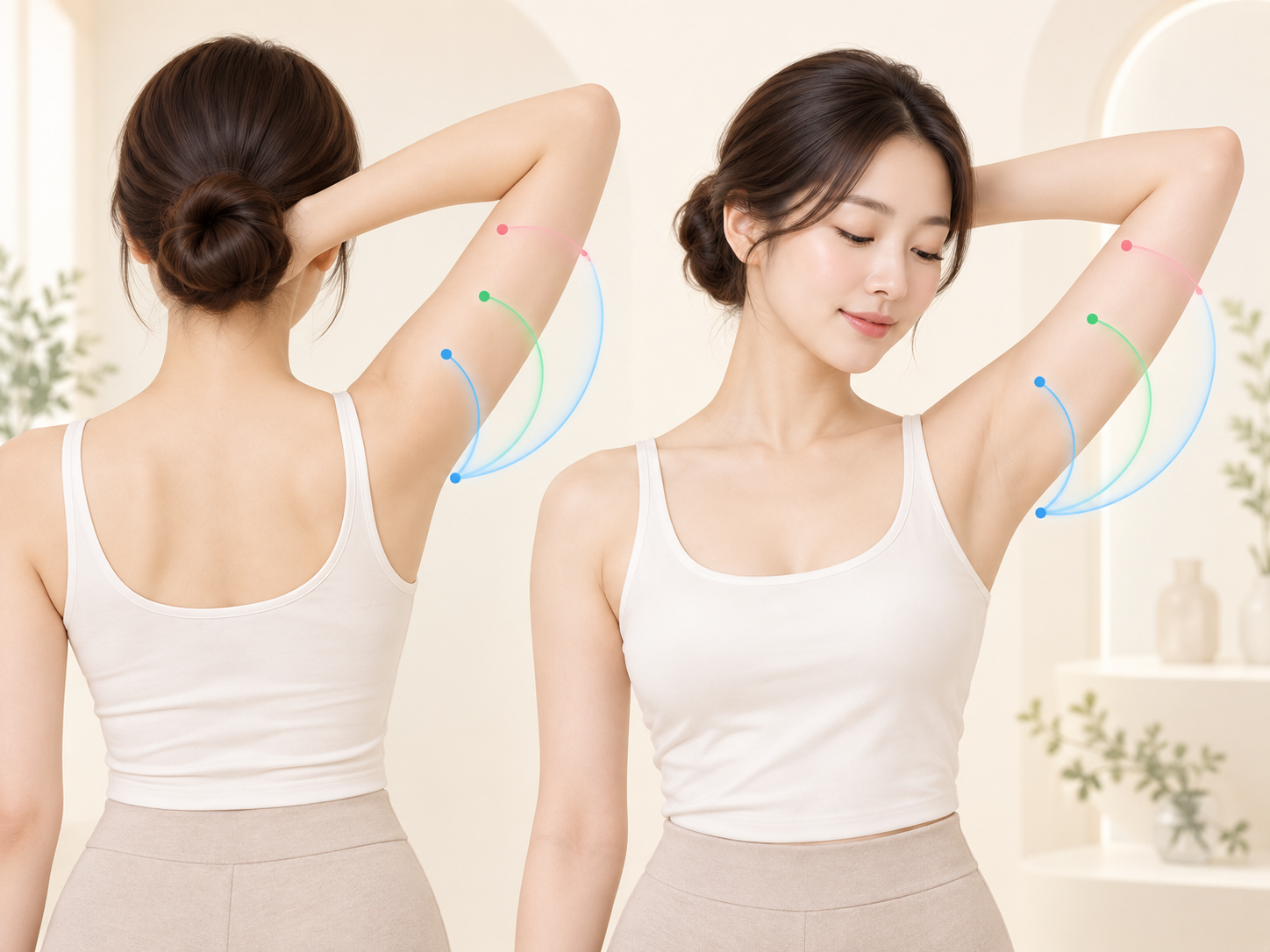
On the arm, a few places meet those conditions: inside the armpit crease, where the inner arm meets the torso, and around the elbow. All three are either folded away or hidden by the body when the arm is down.
Raise the arm and it is a different story. The armpit site becomes visible when you lift the arm high. If you have something coming up where your arms go up a lot — a photo shoot, for instance — it is worth confirming that placement in advance.
Here is where the scars usually sit
Side by side, what each site means.
| Incision site | What it reaches | Everyday exposure | With the arm raised |
|---|---|---|---|
| Inside the armpit crease | Upper back of arm, front and rear armpit | Mostly hidden | Can become visible |
| Inner arm at the torso | Inner arm, mid back of arm | Hidden when the arm is down | Inward facing, less visible |
| Around the elbow | Lower back of arm, above the elbow | Hides in the crease | Tends to show |
| Toward the bra line | Upper back, shoulder blade | Covered by clothing | Behind you, less visible |
The elbow site is easy to overlook. Reaching the lower back of the arm evenly sometimes requires it, and there are angles — raising or bending the arm — where it shows. If you wear short sleeves often, confirm in consultation whether that site will be used.
Placement follows scope. For the arm alone, the top two sites are usually enough; extend through the armpit and back and more sites are needed to get the angles. What changes with each combination is set out in arm liposuction scope.
There may be more than one
This is worth confirming before surgery. Incisions usually do not stop at one site.
The reason is angle. The cannula travels in a straight line, so the directions reachable from any one point are fixed. Treating the whole back of the arm evenly means approaching from different directions, which takes two or more sites.
Treating evenly and minimizing sites trade against each other. Cut down to one site and areas go unreached, and what is left behind can make the surface look uneven. Add sites and you add places that have to heal.
A wider scope raises the count too. Continuing into the armpit or back sometimes means the arm sites alone will not give the angle, so one more is needed. This is knowable in advance, so simply ask in consultation how many sites are planned.
Left and right can differ. Where the fat is distributed differently between arms, the directions of approach differ as well. Hearing that beforehand saves surprise later.
Do scars fade with time?
Here is the usual course — though the speed and the degree vary from person to person.
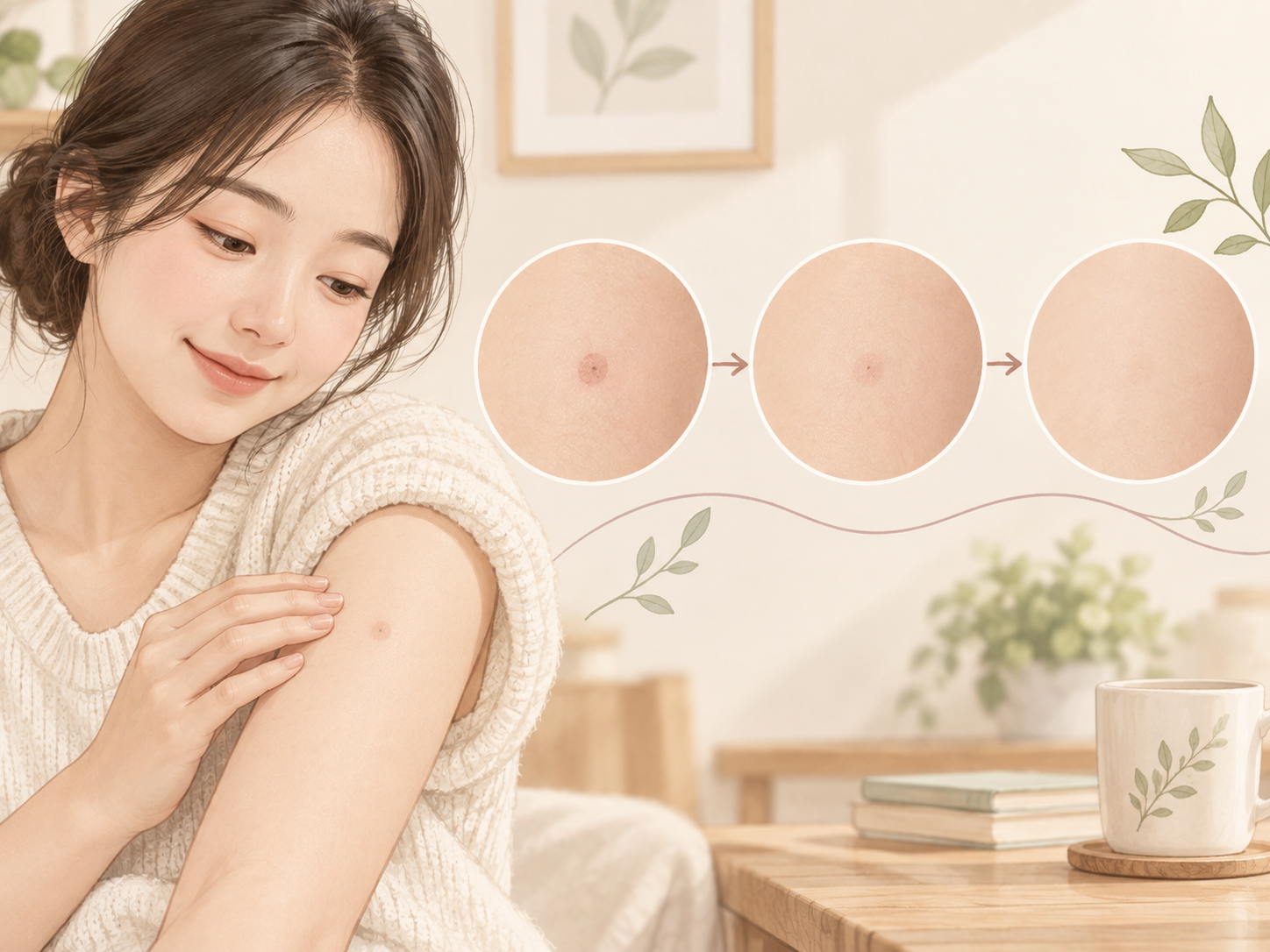
Redness persists after the sutures come out. At around two months it still reads red, with swelling around it. By about three months the redness and pigmentation begin to ease, and at six months substantial fading is common.
Six months does not mean everything has settled, though. If your work uses your arms heavily, that tension affects healing, and some sites raise thicker than the skin around them. Individual skin type matters as well.
We do not tell you there will be no scar. They are small and placed where they are covered, so they do not catch the eye day to day — but the mark itself does not disappear. Starting with that understanding is a different experience from starting without it.
Ultraviolet light can darken pigmentation, so keeping the sites covered for the first few months is better. Have surgery in summer and this becomes a genuine inconvenience. How scars fade and how to care for them is covered in minimizing liposuction scars.
If you want to do this in summer, what should you look at?
If you are considering surgery in short-sleeve season, there is something to look at before scars: bruising.
Incision marks are small and hard to see from any distance. Bruising spreads broadly along the treated area. Treat the whole arm and color comes up as far as below the armpit, darkening somewhere between a few days and a week after surgery. Short sleeves will not cover that window.
So if summer is the plan, start by counting whether the dark-bruise window collides with anything on your calendar. Check whether you have enough time that long sleeves or a light layer can cover it.
The compression garment is also harder in summer. Trapped sweat means humidity, and once that turns into itching, people cut their own wearing time. Compression manages swelling and helps the layers reattach, so inconsistent wear can affect how evenly the surface settles.
If your schedule allows it, waiting for cooler weather is genuinely easier. It does not change the result, though. What the season changes is not the outcome but the conditions you recover in.
How do you care for the incision sites?
What you do while they heal matters more than where they are.
Sutures usually come out between one and two weeks. It depends on the number of sites and how quickly they close. Until then you wash around the area, and scrubbing hard in that window can slow healing.
After the sutures are out, keeping the sun off is the most practical thing you can do. Direct ultraviolet exposure in the first few months can leave darker pigmentation, which is a real nuisance in short-sleeve season. Clothing or sunscreen both work.
When to start taping or ointments is decided by how far healing has come. Starting before the site has closed is an irritation, not a treatment. Beginning earlier does not make fading faster.
Smoking is understood to slow healing. Cutting back around the time of surgery helps the incision sites as well.
If your work uses your arms heavily, that tension affects healing. Repeated movements that pull on a site can leave some segments raised thicker than the surrounding skin. If your job involves heavy arm use, say so in the consultation. It gets taken into account when the sites are chosen.
Worth asking in advance
Three things to confirm in consultation.
How many incision sites are planned, where each one is, and whether those sites show in the positions you are in most often. The third matters most, because whether you wear short sleeves regularly or take a lot of photos with your arms raised can change the criteria for choosing them.
If the answer stops at “we put them where they will not be seen,” you have not been given reasoning. Where on your arm, and why that spot, should come with it.
Incision placement is decided along with scope, so it can be mapped out before surgery. That is why at Line Culture Clinic, when ultrasound has measured the layers and the scope is being set, we also tell you where the entry points will go. If you have something coming up in summer where your arms will be visible, we will count back from that date with you. You are welcome to get in touch.