Arm Liposuction Scope: Wider Is Not Automatically Better
Visit a few clinics and you notice the scope keeps changing. One says the arm alone will do. Another says the armpit and back need to be part of it.
The same arm gets different answers because the standard for setting the scope differs from place to place. So this article does not argue for one combination. It goes as far as laying out, side by side, what each combination changes and what it asks you to accept.
Since I am doing it anyway, is it better to do everything?
Plenty of people ask whether going wide makes more sense given that it is one surgery — one round of anesthesia, one recovery.
That thinking is not wrong, but it needs one premise: the fat has to actually be continuous into that zone. Bring an area into the scope that is not connected and you add recovery burden without gaining anything.
The reverse happens too. When it is continuous and you stop at the arm, a step appears between the treated side and the one left alone. This is where the arm measures smaller but clothes do not look as different as you hoped.
So there is one standard. Not whether you go wide, but whether the stopping point was chosen by looking at your arm.
What each combination changes
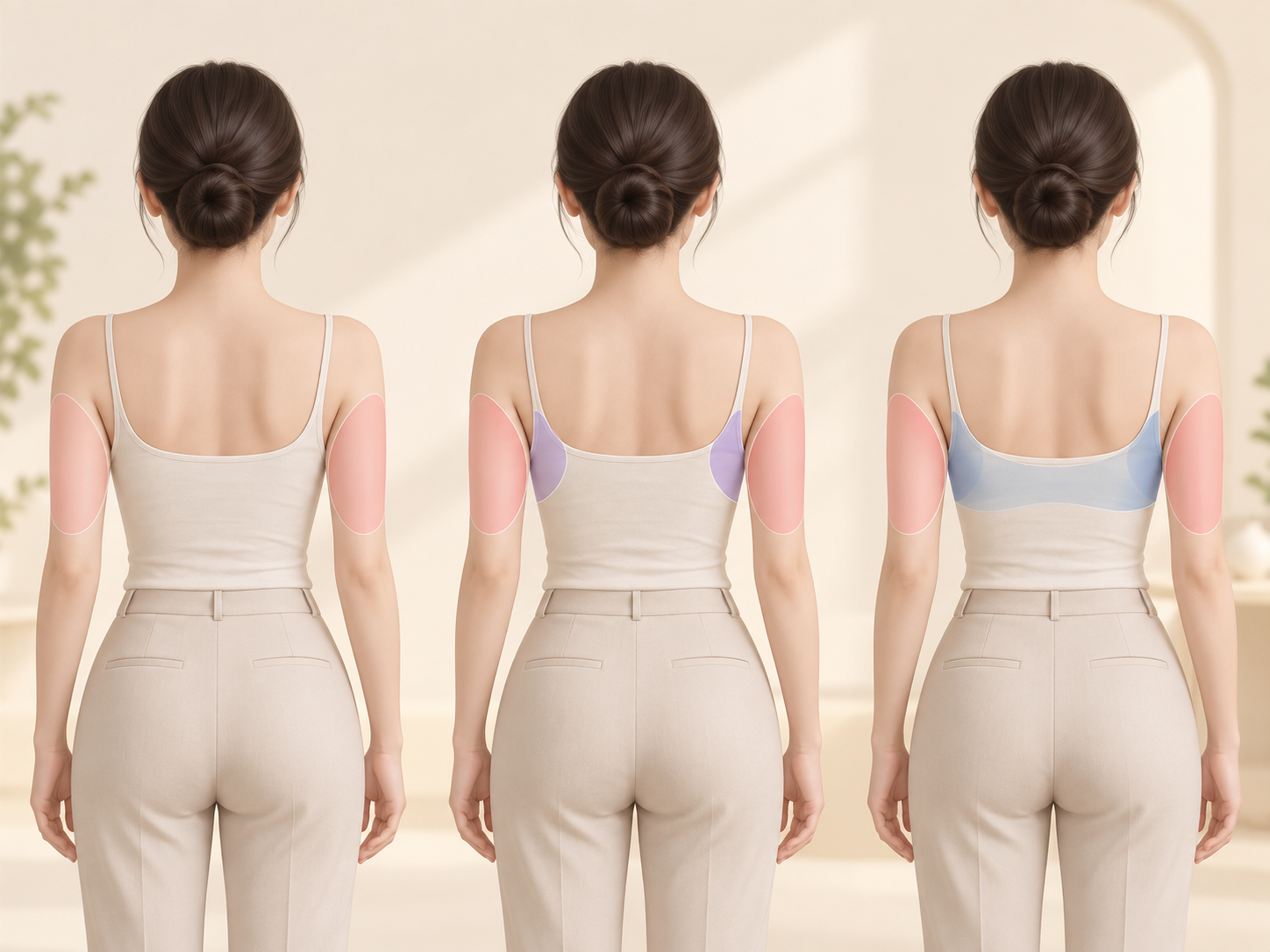
Here are three combinations side by side. The entries describe a common course, and individual results vary.
| Category | Arm only | Arm + armpit | Arm + bra line and shoulder blade |
|---|---|---|---|
| Who it suits | Thickness only at the back of the arm | The side pushes out when the arm is down | Arm and back look disconnected from behind |
| What changes first | Sleeve fit, thickness from the side | Sleeveless side line, arm-raised view | The back surface, lines showing through clothes |
| What remains | The armpit fold, thickness at the back | The line continuing into the back | — |
| Entry points | Inner arm and armpit crease | Usually none added | One more may be needed |
| Compression burden | Limited to the arm | Similar to the arm | Extends across the back, much warmer |
| Final assessment | 3 to 6 months | 3 to 6 months | Tends to run later |
Do not read the table down a column. Start by finding where your own arm sits in the “who it suits” row. Everything below that is what comes with the choice.
Pay particular attention to the third row. Knowing in advance what will remain is very different from finding out afterward. The cases where the result is not poor but the feeling is one of disappointment are usually the ones where that row was left blank.
Is there ever a case for going narrow?
So much writing argues only for widening that it is worth putting the other side first.
When the adjoining zone is clean, the arm alone is enough. If the side line is smooth with the arm against the body, the armpit hollows when you raise it, and the arm carries gently into the back in a rear view, there is no reason to widen.
The same applies when your goal is sleeve fit. If the point is to stop long sleeves from pulling, addressing arm circumference alone meets the goal. Widening the scope when sleeveless tops and the back view are not what you are after adds recovery burden for about the same felt result.
If your weight is still moving, narrower is also better. In a window where fat volume keeps changing, the thickness of the adjoining zones changes too, so a wide plan set by today’s picture becomes an excessive one later.
Wider means longer recovery
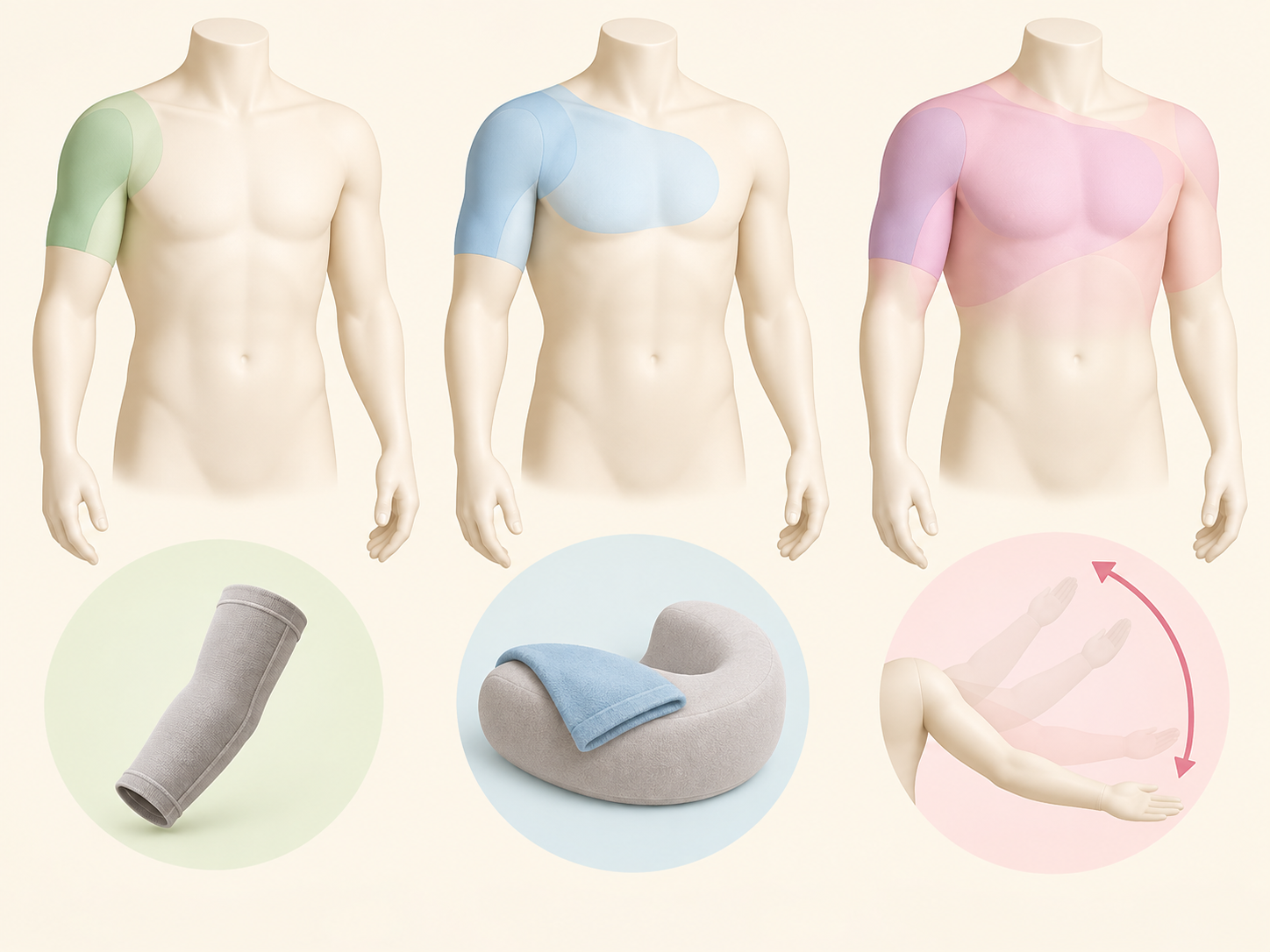
As the scope grows, the recovery stages move later. There is almost no exception to this.
Swelling takes longer to come down, and the compression period extends with it. If the back was treated, the garment covers far more surface, which is considerably harder in summer. There is also now a place that presses when you lie down, so you spend the first few days shifting position.
When you return to normal activity changes too. With the arm alone, most movements are comfortable within a few days. Once the back is involved, twisting the torso and reaching far behind you take longer to feel easy.
So we do not recommend widening the scope when your schedule is tight. And for the same reason we do not recommend cutting the scope short to fit a date. Rather than adjusting the scope to the calendar, move the date back — the result is better. How the body moves through each stage is set out in how long swelling lasts after liposuction.
All at once, or in stages?
If a wider scope is the right read, this is the next question.
| What to check | Do it at once | Do it in stages |
|---|---|---|
| Weight | It has settled | It is still moving |
| Skin elasticity | It supports well | It is on the lower side |
| Time you can clear | A few days are available | Not even one day |
| Goal | Several views bother you | One view bothers you most |
| Previous surgery | None | The arm has already been done |
Here is why we suggest stages when elasticity is on the lower side. Address the arm first, wait a few months, and you see how far the skin tightens. Decide the next scope from that and there are cases where less needs treating than first expected. Take it all wide at once and you never get to use that margin.
If your weight has settled and the skin supports well, doing it in one go has the advantage. Anesthesia and recovery happen once, and the borders between zones can be matched in a single sitting. Matching those borders is the hardest part of a staged approach.
Can the scope be widened later?
People often ask what happens if they start narrow and end up wanting more. It can be done — with conditions on timing.
Wait at least three to six months. While swelling is still present, there is no separating what is still recovering from what fell outside the scope. Plan a second round without that distinction and you end up including areas that never needed it.
The wait gives you something, too. How far the skin tightens becomes visible in that time. As the treated area settles, the adjoining zone sometimes stands out less than expected, and the second scope shrinks below the original estimate.
The hard part is matching the borders. Where the area treated first meets the area treated second has to read as continuous, and a layer that has already healed behaves differently from untouched tissue. That is why it helps enormously to have a record of which layers were treated and what was left.
When planning a second round, revisit the view you set out to change the first time. If sleeve fit was the goal, it may already be met — in which case there is no second round. Rather than widening the scope because something feels unfinished, narrow down what exactly feels unfinished, view by view.
This is why staying with the same clinic helps. With pre-op photographs and a record of the layers, matching borders in a second round is far easier. Without records, the second round has to be judged on what is visible today.
Ask it this way in consultation
What you want is the reasoning behind the scope.
How far should my arm be treated, and what is that based on? If the answer ends at “anything is possible” or “we can include it,” you have not been given reasoning. What should come with it is which part of your arm looks how, and why that led to this scope.
What will be left if I do the arm alone? Clinics divide sharply on whether they answer this concretely. The ones that name what remains leave less disappointment later.
One more. Check whether they look at and explain the arm lowered and raised, from the front and from behind. The arm changes shape dramatically with position, so setting the scope from one view leaves zones out. What to confirm in a consultation is set out in what to check in an arm liposuction consultation.
How far the fat actually runs is not something hands can determine. That is why a consultation at Line Culture Clinic measures the back and front of the arm, the armpit, and the shoulder blade area with ultrasound and reviews photographs in each position. If you are finding the choice between a wide and a narrow scope hard to make alone, let us look at the numbers and decide together. You are welcome to get in touch.