Why the Armpit Line Still Looks Unchanged After Arm Liposuction
Around a month after surgery, most people stop in front of the mirror at some point. The arm is clearly smaller, but the bulge at the side — the one that bothered you most — looks exactly as it did.
To say it up front: looking that way at this stage is common. There is, however, a standard that separates a common course from one that is not, and knowing it tells you whether this is a time to wait or a time to check.
The arm came down — why not the side?
There are reasons the armpit settles late. Three of them overlap.
First, it is a place where tissue overlaps. The front of the armpit is where the arm meets the torso, so several layers stack up there. The same amount of swelling pinches thicker in a spot where layers overlap.
Second, it is a junction where lymph collects. Circulation returning from the arm passes through this area. Swelling from the treated zone gathers here before draining, which creates a pattern of settling later than the arm.
Third, it moves all day. Every time you raise and lower the arm, this area folds and opens. Repeated stimulation slows the rate at which things go down.
So the common order is that the arm settles first and the armpit follows. That is why there is a stretch around the one-month mark where it feels as though only the side line is left.

Is it still swelling, or was it never removed?
Three things need separating here. What you do about each is completely different.
| What to check | Still recovering | Outside the scope | Not fat at all |
|---|---|---|---|
| Week-to-week change | Coming down a little at a time | Unchanged | Unchanged |
| Left versus right | Both sides similar | Both sides similar | One side can be larger |
| How it feels | Soft, with blurred edges | Same as the fat around it | Firmer and knotted |
| Menstrual cycle | No relation | No relation | Size or tenderness changes |
| Pre-op photos | It was there before | It was there before | It was there before |
The easiest standard is the first row. If it is coming down even a little each week, you can wait. Pinch the same spot the same way two or three weeks apart and the direction becomes visible. Unchanged, or feeling as though it is spreading, is when a check is needed.
The third row helps too. Swelling still in recovery is soft with blurred edges, while remaining tissue feels knotted and distinct from what surrounds it. That said, for the first two or three months there is a phase where healing tissue firms up temporarily, so this alone is not conclusive.
The last row is actually the most reliable. If you have photographs taken from several angles before surgery, whether what is left was there all along or is new becomes clear immediately. That is exactly why we ask you to record the arm against the body and raised, from the front and from the side, before surgery.
How far along should things be right now?
Knowing the timeline keeps you steadier through the middle of it.
Right after surgery the armpit swells too, so it actually pinches larger. Between weeks two and three the major swelling comes down and the arm visibly shrinks first, while the armpit still looks unchanged. Between one and two months it begins to follow, and the final assessment comes at three to six months.
If a wide area was treated or skin elasticity is on the lower side, every stage shifts later. That is why two people who had the same procedure on the same day do not progress side by side. Rather than comparing your one-month mark to someone else’s, compare your own two-week mark to your own one-month mark.
Match your conditions when you compare. Same place, same lighting, same posture, two weeks apart, laid side by side — the difference shows. Check the mirror every day and your eye adapts, so you miss the gradual change. How the body moves through each stage is set out in how long swelling lasts after liposuction.
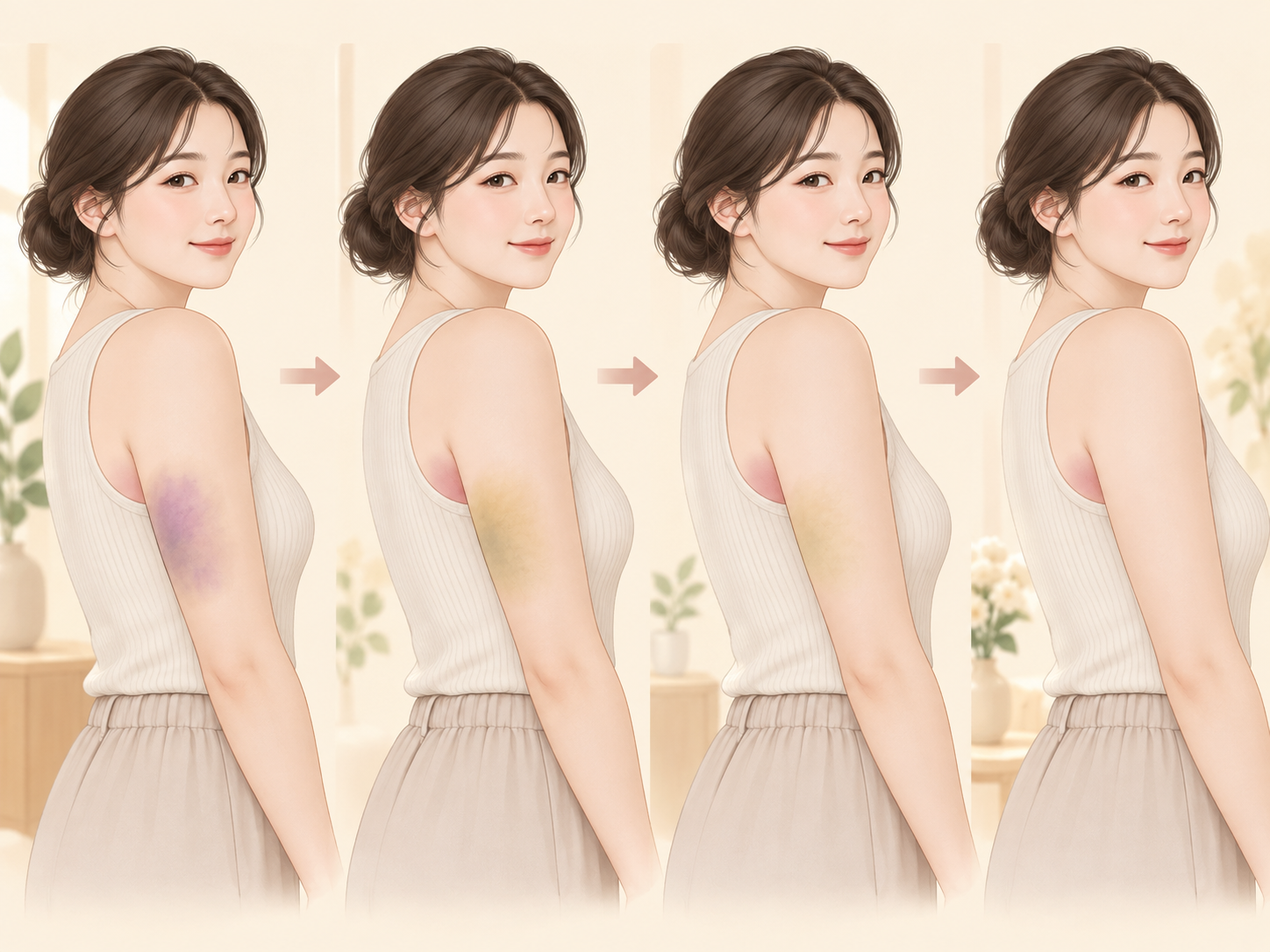
Why the armpit gets looked at alongside the arm
If you are still before surgery, this part is even more useful.
Fat at the back of the arm forms one line with the fold at the front of the armpit and with the area continuing back toward the bra line. They look separate in the mirror, but as a fat layer they are continuous. Address only the arm and leave the adjoining zone, and a step that was not there before can appear between them.
This is where the case comes from in which the arm measures smaller but clothes do not look as different as expected. Sleeveless and fitted tops show the side line where arm meets torso more than they show the arm itself.
If the adjoining zone is clean, on the other hand, there is no reason to widen the scope. What matters is not going wide but whether the stopping point was chosen by looking at the arm. Whether the front of the armpit folds, whether the bulge pushes forward, whether there is thickness continuing to the bra line — those are checked in order, and then the decision is made.
When to let us know
Here is what can be waited out and what needs checking. The same symptom means different things at different stages.
| Stage | Common course | Tell us when |
|---|---|---|
| Day of surgery to day 3 | Armpit swells and pinches larger | One side swells sharply or feels hot |
| Around suture removal | Swelling starts coming down | Drainage continues |
| 3 weeks to 1 month | Arm settles first, armpit still looks full | One side hardens and the area widens |
| 2 to 3 months | Firm areas start softening | A firm area stays exactly as it is |
Keep one standard. If it is improving even slightly week to week, you can wait. Unchanged, or feeling as though it is spreading, is when to tell us.
If your work uses your arms heavily, recovery at the armpit can feel slower. It is a place where movement repeats, so stimulation accumulates. Even then, as long as the direction is downward, it is a common course.
We also do not recommend strong massage or radiofrequency early on. Stimulating a layer that is still healing can increase swelling instead. When treatments start and at what intensity is set, and moving that date earlier does not move recovery earlier. When and how strongly to begin is decided as the course unfolds.
Feeling a difference between left and right also comes up often in this window. Very few arms are perfectly symmetrical to begin with, so in many cases the original difference — hidden until now by swelling — is simply becoming visible. Whether it was created by surgery or was there all along becomes clear when compared against pre-op photographs.
Before surgery, one question is enough
Ask it this way in your consultation: will my arm do on its own, or does the armpit need looking at too?
If the answer stops at “we can include it in the scope,” you have not received the reasoning. What should come with it is which part of your arm looks how, and why that led to the decision. It comes down to whether they look at your arm both against the body and raised, and explain what they see.
One more worth asking: whether what is felt at the armpit is fat or contains glandular tissue. Where glandular tissue dominates, the amount suction can reduce is limited, and if that is not separated out beforehand, the dissatisfaction later sits exactly on that boundary. Which it is becomes clear only through ultrasound. The criteria for looking at the arm and armpit together are covered in arm liposuction and accessory breast tissue.
To sum up: after surgery, use whether it is coming down even slightly week to week as your standard. If it is, this is a time to wait. If it is unchanged or feels as though it is spreading, this is a time to check. And if you cannot tell which, that is worth telling us too.
When something ambiguous comes up during recovery, the person who knows your starting state can tell fastest whether to wait or to look. Someone who knows which layers were treated and how much asymmetry you started with reaches a judgment quickly. That is why at Line Culture Clinic the person who performed the surgery also follows the course. If you are unsure whether the stage you are in is a common one, do not measure alone — get in touch.