Fall Liposuction: Conditions That Favor Arm Recovery
Arm consultations increase as summer ends. Many people say their arms kept bothering them in photos over the months they spent in short sleeves.
Search for fall liposuction and the first thing you read is that now is the right time. That is not wrong, but articles that pin down exactly what is favorable are rare. What becomes favorable is not the result but the conditions for getting through recovery. Blur the two together and the season starts rushing your decision.
What the season changes is not the result
Let us draw a line first. When you have surgery does not change the final result.
What determines the result is where your arm’s fat layers sit and how much there is, how much skin elasticity you have, which layers were addressed, and how much was left. Recovery speed likewise comes from the treated area and individual conditions. There is not much room for the season in any of that.
So why does the season come up at all? Because the daily life you live through recovery changes. The result does not improve; those few weeks simply become easier to pass. Keeping this distinction stops you from hurrying because of the calendar.
There is another reason the distinction matters. Tying season to result also creates the misunderstanding in reverse: that people who had surgery in summer must have had poor results, or that missing this window means waiting until next year. Neither is true. How recovery was managed is what remains, not when it happened.

Why compression wear feels different from summer
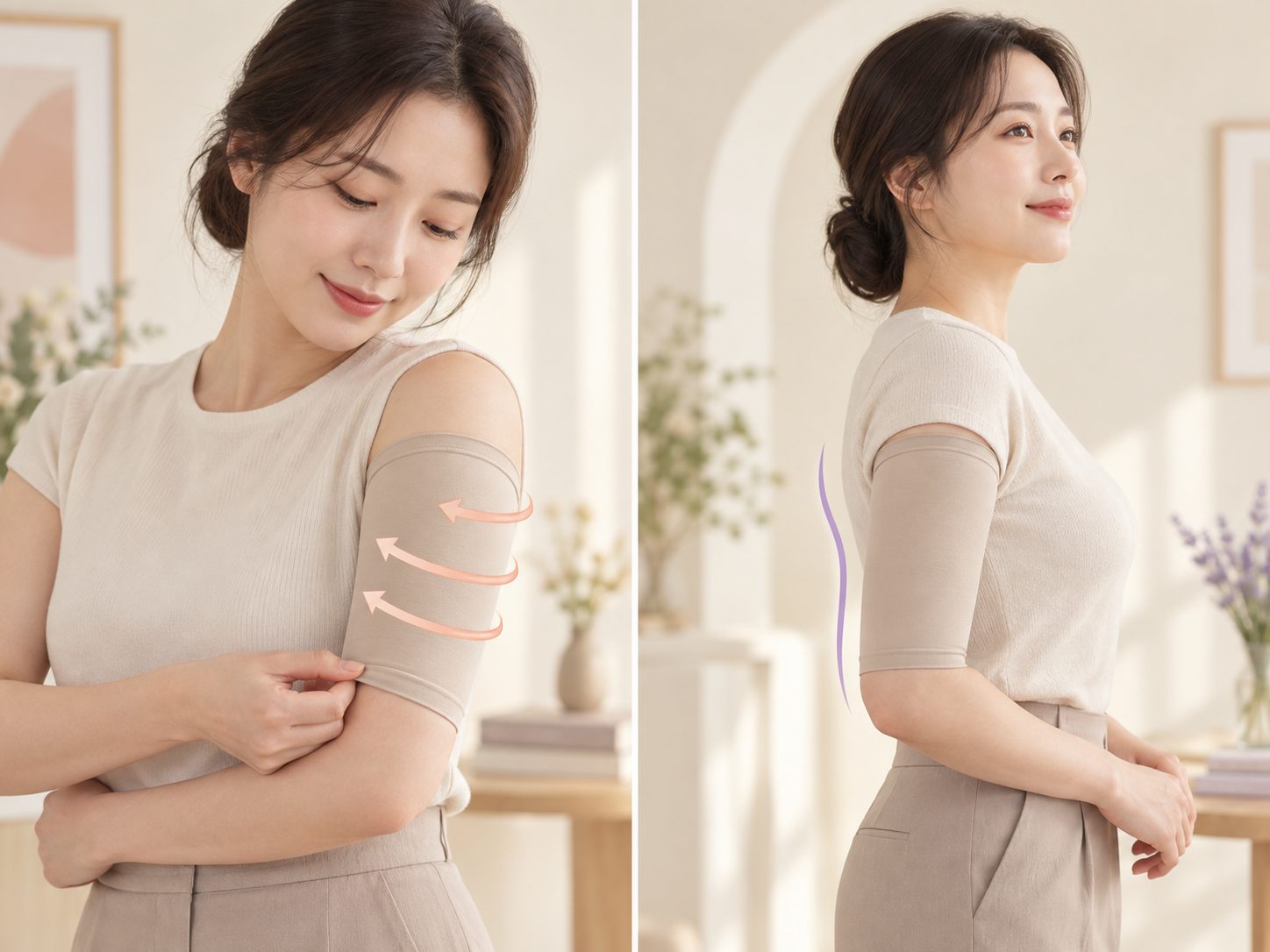
After arm liposuction, compression is maintained for a set period. Compression wear means a dedicated garment that presses the treated area evenly. How this period feels differs considerably by season.
In summer, sweat is the problem. Sweat trapped inside the garment makes it humid, and that sometimes leads to itching or a rash. You then start cutting wear time on your own. Compression manages swelling and supports the process of the layers reattaching where fat was removed, so when wear becomes irregular, the flow of recovery wavers with it.
Fall reduces that burden. With less sweat it is easier to keep the garment on, and a long sleeve or thin knit hides the marks it leaves. For people who go to an office or meet others often, this genuinely matters. Simply not having the arm exposed during the stretch when bruising darkens puts people at ease.
Understanding why compression is needed also makes it easier to keep wearing. Removing fat leaves an empty space, and compression reduces that space to support the tissue reattaching. It also presses against edema pooling in one place. So irregular wear does not so much delay recovery as affect how evenly the surface resolves. That is where the ease of skipping it in summer leaves its regret.
That said, finding it easier to wear does not mean the compression period shortens. The period is set by the treated area and the course of recovery, not by the season.
One note about clothing. Being covered by long sleeves means others do not notice; it does not mean recovery is faster. If anything, being covered means you check less often, and differences between sides or one side hardening are sometimes noticed late. Even with fall surgery, it is better to raise your arm in front of a mirror and check every few days.
There are also cases where layering heavy clothes over the garment increases the stuffiness. That burden grows as winter approaches. So judged purely on how the compression garment feels, early fall sits in the best stretch between summer and midwinter.
One more thing. Once heating comes on, it is cool outside and warm indoors. That creates stretches within a single day where how it feels diverges. If an outer layer lets you adjust, it is fine, but if your work keeps you indoors for long periods, a burden similar to summer remains. Rather than going by season alone, it is more accurate to consider where you spend your day.
| Start | When bruising and swelling stand out | Covered by clothing? | When you see the result |
|---|---|---|---|
| September | Mid-September to early October | Long sleeves suffice | December to March |
| October | Mid-October to early November | Knits and outerwear are enough | January to April |
| November | Mid-November to early December | Heavy clothing is enough | February to May |
| December | Mid-December to early January | Enough, but it overlaps with gatherings | March to June |
What to look at in the table is not the second column but the last. Start in fall and the point at which you assess the result falls in the following spring.
Start in September and when will the result show?
For the arm we allow three to six months to the final assessment. Have surgery in September and the line settles around December, or runs to the following spring at the later end.
There is a reason this calculation matters. If your goal is wearing short sleeves comfortably next summer, you have ample time. If you have a nearer commitment, such as an end-of-year gathering or a winter shoot, the arithmetic changes. Starting in September for an early-December date lands you in a stretch where swelling has largely cleared but the line is still resolving.
It also helps to hold one standard for counting. If your goal is a change in how clothes fit, allow about one month to six weeks; if your goal is a setting where the arm is bare, allow three months or more. Situations with a fixed angle, like a photo shoot, belong to the latter. Even for the same surgery, the time you need changes with what you want to gain and by when.
If you have a date, counting backward from it is the fastest approach. Tell us what is on your calendar and whether to start now or wait separates on the spot. How the body progresses stage by stage is set out on the Post-Surgery Care page.
Some things hold regardless of season. Recovery speed differs from person to person, and even with the same area treated at the same time of year, swelling clears at different rates. So choosing a good time does not guarantee a schedule.
If your timeline is tight, narrowing the treated area to fit it may come to mind. That is an inverted judgment. The arm is a line running into the armpit and the bra line, so cutting the area short to meet a date can create one more visible line between what was treated and what was left. Rather than shrinking the area for a date, it is better to push the date back.
Something to settle before the season
Before settling on timing comes the question of what state your arm is in now. However good the season, a state that does not fit is not a reason to start.
If your weight moved over the summer, we look at that first. If weight loss is ongoing or you lost a large amount recently, the thickness you can pinch now is not the final one. Where the loss was rapid in particular, the skin has not had time to follow, and you pass through a period of looking looser than you are. Judging then overstates the elasticity problem.
People who swelled a lot over the summer also need to allow time. Heat can swell the arm, and taking a measurement in that state leads you to conclude there is more fat than there is. If the circumference differs noticeably between morning and evening, or a fingertip mark lingers, edema may be mixed in — and edema is not something to remove. Measuring again once the weather cools sometimes gives a different number.
Conversely, if your weight has settled and only the back of the arm remains, this is indeed a good time to get it checked. We gauge thickness by hand, then use ultrasound to confirm whether the fat is concentrated in the superficial layer or sits in the deep one. We photograph the arm lowered and raised. Only once this is done are the treated area and the thickness to leave decided. What to review before surgery is set out on the Pre-Surgery Examination page.
Fall is favorable, yes. But that advantage extends only as far as making recovery easier to get through. Starting because the season is good, and starting after checking your arm’s condition and finding the season happens to suit, produce the same result by different processes.
The season suiting you and your arm suiting surgery are different matters. Whether the thickness you can pinch now is final, and whether summer edema is mixed into it, separate only under ultrasound and photographs. If you have something on the calendar between now and spring, counting backward from that date is part of a consultation at Line Culture Clinic. Let us look together at whether this is a time to start or a time to wait.