Muscular Arms and Liposuction: Can They Actually Get Slimmer?

When you flex your arm and it feels firm, most people reach the same conclusion: I am the muscular type, so there is nothing to remove. Among those who put off a consultation for a long time, this is a common reason.
If you have looked into it this far, you have probably read several articles already. Yet most of them only argue whether liposuction works on muscular arms. What they rarely tell you is how to determine whether your own arm is actually the muscular type.
Is that thickness at the back of your arm really muscle?
Arms that are thick because of muscle are rarer than you would expect. The thickness you can grip at the back of the arm is, in most cases, subcutaneous fat sitting over the triceps.
The reason lies in the structure. The triceps is the muscle on the opposite side from the biceps. It attaches along the back of the upper arm, and a layer of subcutaneous fat covers it. When you flex, the muscle underneath contracts and pushes the fat above it upward, so the whole area feels firm. The firmness your hand registers belongs to the muscle, while the thickness you can pinch belongs to the fat. Because the two are stacked, your fingertips alone cannot separate them.
That does not mean arms with a large muscle component do not exist. Among people who have trained for years, triceps volume can genuinely be substantial. Even then, however, what liposuction can reduce stops at the fat above the muscle. The muscle layer is not a target for suction. That line is the same at any clinic.
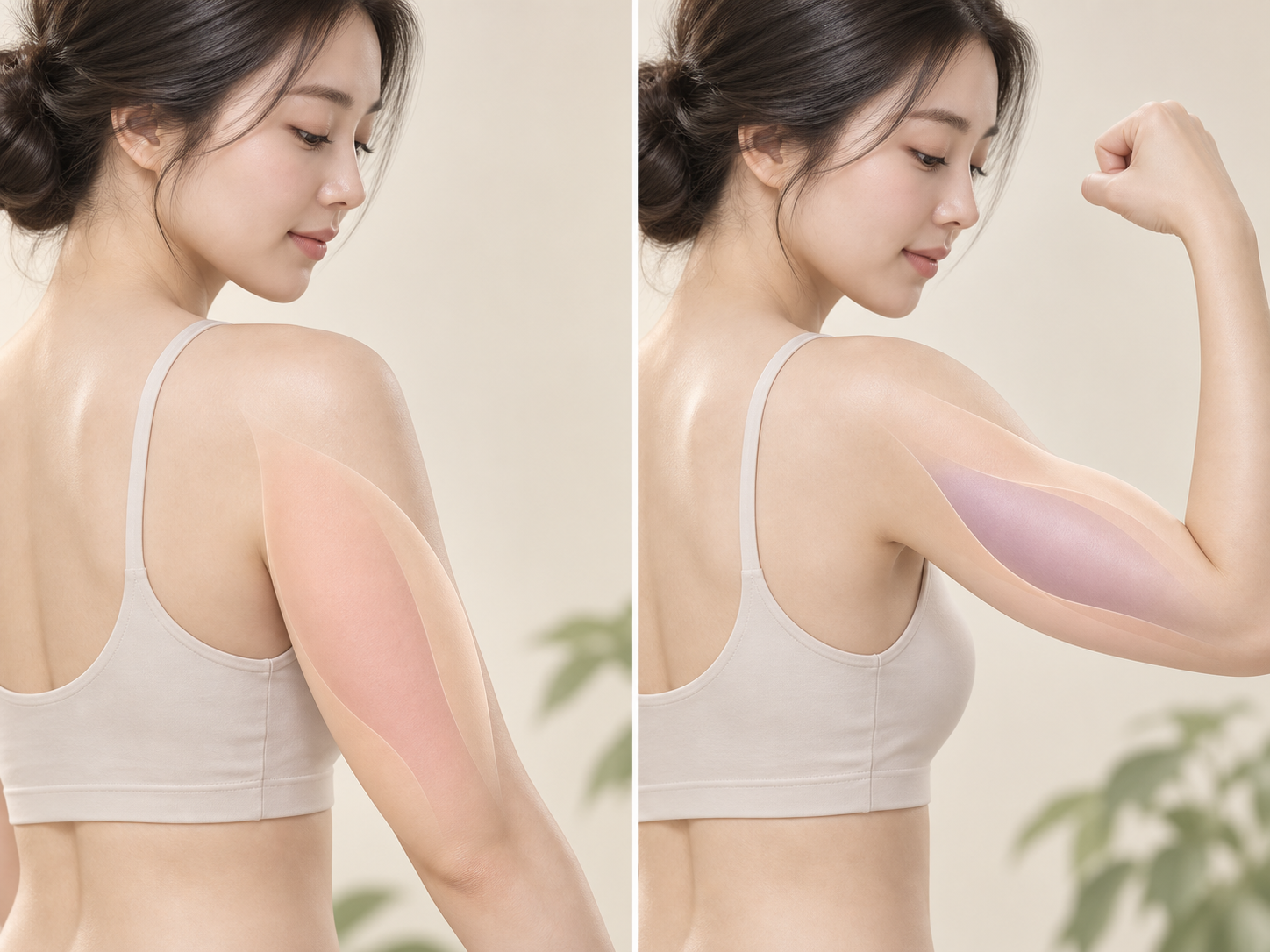
Why flexed and relaxed feel different
There is a check you can do at home. Look twice.
First, with your arm completely relaxed, pinch the flesh at the back of your upper arm between your fingers. If it comes up thick, a considerable part of that thickness is fat. Next, pinch the same spot while flexing. If it still comes up thick even when flexed, that much fat is sitting on top. If what you can pinch shrinks sharply the moment you flex, the muscle component is on the larger side.
This is called the pinch test, and put simply, it means gripping the skin between your fingers to gauge its thickness. The principle is the same as what we do at the clinic. Do it on each arm separately, and compare at the same spot. Fat distribution differs between the inner and the back of the arm, so even a small shift in where you pinch changes the result.
There is a third possibility that is easy to miss: swelling. If the circumference differs noticeably between morning and evening, or if a fingertip leaves a mark that fades slowly, swelling may be mixed in. Swelling is neither fat nor muscle, so it is not something to remove, and building a plan while mistaking it for fat sets expectations off course.
One more thing. Fat and muscle are not the only things that create arm thickness. The amount and distribution of subcutaneous fat, muscle mass, and bone structure all work together. Skeletal frame is not reduced by any surgery, so thickness remains even after the fat is addressed. If you divide the reasons for a thick arm into fat and muscle only, this third factor drops out, and your expectations end up misaligned.
Telling muscular, fatty, and mixed arms apart
Line up three checks and a direction emerges. Please read this as a reference for gauging which component dominates, not as a diagnosis.
| Check | Muscle-dominant | Fat-dominant |
|---|---|---|
| Pinching while relaxed | Comes up thin | Comes up thick |
| Pinching while flexed | Sharply less to grip | Still thick |
| Raising and shaking the arm | Barely moves | The back follows and sways |
| Profile from the side | Rises into a bulge above the elbow | Gentle from shoulder to elbow |
| When you lost weight | Circumference changed little | It shrank to some degree |
It is actually uncommon for all five items to fall on one side. Most people come out mixed, and that is the mixed type. With a mixed arm there is a clear margin to gain from addressing the fat, but that margin is not as large as it is for a purely fatty arm. Establishing how far your arm can slim down, rather than how much it will slim down, changes how you receive the result.
Pinching by hand takes you only this far. Ultrasound measurement gives fat thickness in millimeters for the back and front of the arm, the scapular area, and the deltoid separately. This is where cases turn out to have a modest amount of actual fat and a dominant muscle mass, despite looking thick from the outside. We review photographs alongside it: arm down and arm raised, front and side. The arm is an area whose appearance shifts greatly with posture, so a single photograph does not settle the question.
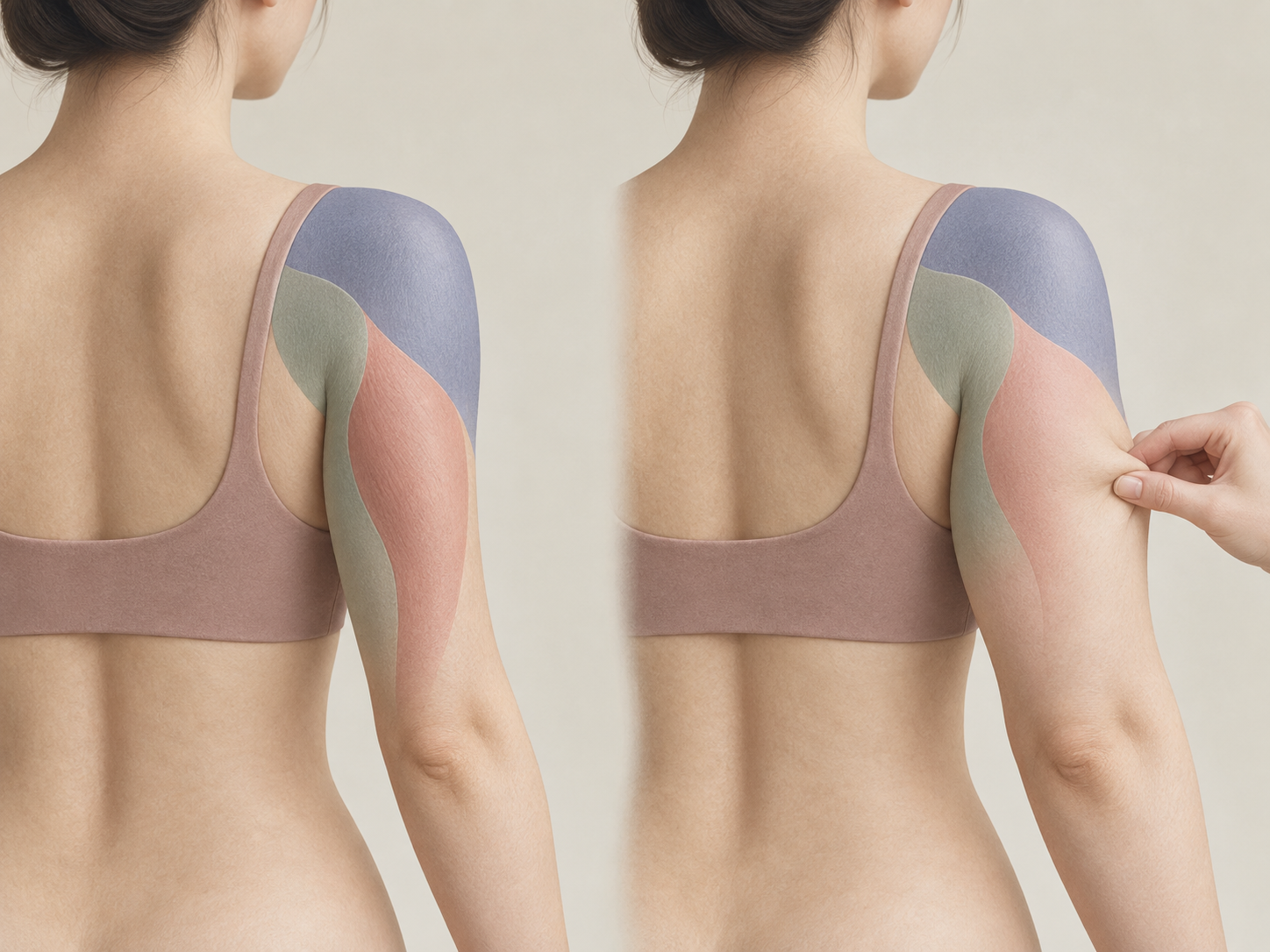
If the arm really is muscular, how far can it go?
If the check confirms that the muscle component truly is large, a plan built on a big drop in circumference does not fit. In that case, what liposuction addresses is the shallow layer that was blurring the muscle contour.
That is not meaningless, though. On a muscular arm, what actually bothers people is often not the arm itself but the fold where the front of the armpit meets the arm, and the rear border running into the scapular area. These zones accumulate fat rather than muscle, so they can be addressed. Treating the armpit as well creates a defined line when the arm is raised, and reducing volume near the scapula shrinks the area that was masking the arm when viewed from behind. Even when arm circumference barely changes, this is where the margin for a tidier upper-body silhouette comes from.
There is one more point. Removing too much fat actually makes the muscle contour stand out. You may end up looking firm and muscular when the goal was a softer look. So on a muscular arm we plan to leave some fat over the muscle borders to cover the contour. The same applies around the elbow: a little must remain so the upper and lower arm do not look disconnected.
If your goal is a slender arm, a muscular build is certainly a disadvantage. If your goal is to clean up the line running from shoulder to elbow, the story changes. That is why we ask about your goal first in consultation. Trying to solve both goals at once with the same approach tends to end without satisfying either. What to leave and what to address is laid out by region on the Arm Liposuction page.
Where to end the treatment area is also decided here. Addressing the arm alone while leaving the front of the armpit can create a visible step between the two zones that was not there before. On a muscular arm the change in the arm itself is small, so that border stands out relatively more. The larger the muscle component, then, the smoother the result tends to be when the adjoining zones are considered together rather than keeping the area narrow.
Even under the same conditions, the range of results differs from person to person, because fat layer thickness, skin elasticity, and recovery speed all vary. Rather than promising numbers, we prefer to decide together in consultation which direction to take and how far to go.

Years of exercise does not always mean more muscle
One last point worth noting: training history and actual muscle mass do not always match.
People who have done mainly cardio for a long time often have a high training volume but modest arm muscle volume. Conversely, some people have barely exercised yet have genetically well-developed triceps. And for those who have repeated several rounds of dieting, muscle mass may actually have decreased while the arm stayed the same, leaving the fat component larger than it used to be.
We also do not recommend judging right after weight loss. While your weight is still moving quickly, fat volume keeps changing, so the thickness you can pinch now is not the final one. If the loss was rapid in particular, the skin has not had time to follow, and you pass through a period of looking looser than you actually are. Deciding whether you are the muscular or the fatty type during that window puts the judgment off either way. Looking once your weight has settled is more accurate.
So the conclusion that you are the muscular type should come from your arm as it is now, not from your training history. Why a thin arm is not always a good outcome is covered in Arm Liposuction, and what to review before surgery is set out in Pre-Surgery Examination.
If the flesh comes up thick when relaxed and the back of your arm follows and sways when you raise it, being the muscular type is not a reason to postpone. If instead what you can pinch disappears the moment you flex and there is a bulge above the elbow, it is better to first establish which zones to address rather than planning to reduce circumference.
Something remains even after you have gauged it by hand. How many millimeters of fat actually sit over the muscle only comes out when it is measured. That is why a consultation at Line Culture Clinic measures the back and front of the arm, the scapular area, and the deltoid separately with ultrasound, and reviews photographs by posture alongside. If you have been putting it off because you assumed you were the muscular type, start by checking whether that assumption holds, and please feel free to reach out with any questions.