Abdominal Liposuction: Why the Lower Belly and Flanks Go Together
People considering abdominal liposuction usually describe the same things: the lower belly folding, flesh sitting over the waistband, or a waistline that will not emerge no matter how much weight comes off. The abdomen shows its silhouette directly through clothing, so even small changes register very differently from person to person.
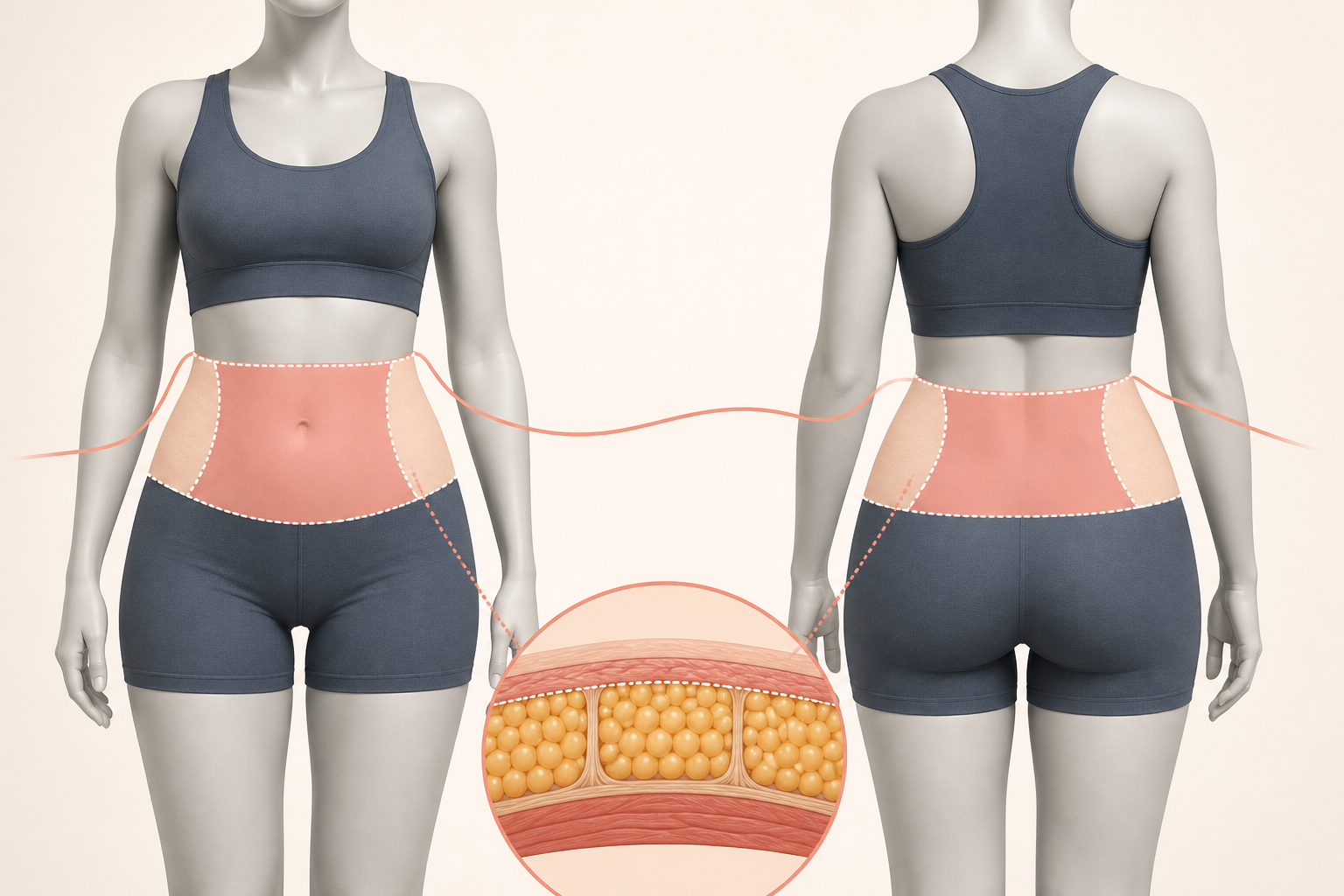
Treating it as “an operation that flattens the stomach” falls short. The upper abdomen, lower abdomen, flanks, and lower back have to be read as one continuous line before the result looks natural.
What matters is not how much comes out but establishing what type of fat you are carrying, and planning what to reduce and what to leave. Subcutaneous fat, visceral fat, skin elasticity, and the state of the abdominal muscles all feed into the outcome.
When does it suit?
Abdominal liposuction reduces the subcutaneous fat that pinches just beneath the skin, to resolve the line. It is considered less for weight loss than for a specific concern — a protruding lower belly, the flanks, the waistline.
- The lower belly folds or sits over the waistband
- Flanks and love handles bulge, blurring the waistline
- One part of the abdomen will not respond to diet and exercise
- The subcutaneous layer pinches relatively thick
- How clothes sit matters more to you than the number on the scale
Conversely, if the abdomen protrudes firmly but there is not much fat to pinch, visceral fat, bloating, and muscle condition all need looking at. In that case liposuction alone will not flatten it the way you hope.
Lower belly only, or the whole abdomen?
Scope is where most of the confusion sits in consultation. Addressing the lower belly alone seems sufficient, but in practice the flanks and love handles remain, and the change to the waistline reads as small.
A smaller scope is not automatically the better choice. The abdomen is continuous, so reducing one area can make the fat around it stand out by comparison.
So when setting the scope we look at the silhouette from the front, at 45 degrees, and from the side. What bothers you from the front may be the lower belly, while from the side it is the flow from the flank into the lower back that is breaking the line.
What to look at when assessing results
Beyond how much smaller the abdomen is, these points tell you about the quality of the change.
- Whether the lower belly reduces while carrying naturally into the upper abdomen
- Whether the flanks and love handles resolved along with it
- Whether the 45-degree and side silhouettes changed, not only the front
- Whether the skin surface looks hollowed or uneven anywhere
A good result is not simply a smaller abdomen. Waist width, the curve of the flank, lower-belly projection, and the line above the hip have to resolve together before the change reads naturally in clothing.
Does it reduce visceral fat?
Abdominal liposuction reduces the subcutaneous layer you can pinch beneath the skin. Visceral fat surrounding the organs is not what this operation removes.
So the first question is whether your abdomen is subcutaneous-dominant, visceral-dominant, or a mix of the two. Where visceral fat dominates, lifestyle management and a health assessment come before surgery.
Related: abdominal liposuction
What decides the outcome
Satisfaction is not settled by volume removed. Fat layer thickness, skin elasticity, incision placement, recovery management, and surgical scope all work together.
- Fat layer thickness: there has to be enough subcutaneous fat for a change in the line to show
- Skin elasticity: if the skin cannot follow the reduction, laxity or creasing remains
- Surgical scope: lower belly only versus continuing into the flanks changes the impression entirely
- Incision design: openings planned small and placed where they show least
- Aftercare: compression, swelling management, firmness management, and daily habits shape recovery
We establish the abdominal fat layers and skin condition first, using ultrasound, photographic review, and a pinch test. Rather than deciding volume by impression, the process is about seeing what to reduce and what to leave for a natural waistline.
Related: pre-operative testing, post-surgery care
Six things to settle before your consultation
- Which bothers you most: lower belly, upper belly, or flanks
- How much fat you can actually pinch
- Whether the abdomen pinches soft, or protrudes firmly
- Whether there is a history of childbirth, abdominal surgery, or rapid weight change
- Whether skin laxity or stretch marks are part of it
- Whether your schedule allows for compression garments and follow-up visits
Arriving with these settled makes it far easier to pin down the scope and the change that is realistic. Establishing the current state of your abdomen beats deciding suitability from what you can read online.
At Line Culture Clinic, in a private space near Exit 3 of Apgujeong Station, we confirm the abdominal fat layers and skin condition and then discuss the design of the line rather than the volume to remove.
Results, swelling, bruising, scarring, pigmentation, changes in sensation, and recovery time all vary from person to person. If you cannot decide between the lower belly alone and continuing into the flanks, bring a front and a side photograph — it narrows quickly.