How Long Does Swelling Last After Liposuction?
The most practical worry when considering liposuction is how long the swelling will last. For plenty of people, work, plans, exercise, the compression garment, bruising, and firmness weigh more heavily than the operation itself.
Facial and double-chin liposuction call for more caution, because the swelling is immediately visible. The abdomen, arms, and thighs can be covered by clothing; on the face, even a small amount of swelling feels significant to the person carrying it.
How long swelling lasts depends on the area, the range treated, the thickness of the fat layer, skin elasticity, how much bleeding occurred, and how recovery is managed. This article sets out, realistically, what changes at each stage and when it makes sense to start planning around your life again.
Why does swelling happen?
Liposuction removes fat by passing a thin cannula through the subcutaneous layer beneath the skin. In the process, it is not only fat cells that are affected — the capillaries, lymphatic vessels, and connective tissue around them are also disturbed to some degree.
Swelling is the body’s natural response to that. Fluid lingers between tissues, lymphatic circulation slows temporarily, and the solution introduced during surgery remains for a time before being absorbed.
So swelling does not in itself mean something has gone wrong. How much there is, and how quickly it goes, does vary from person to person.
- The wider the area treated
- The thicker the fat layer, or the more fibrosis present
- The more easily you bruise
- The more prior surgery or procedures in the area
- The less consistently compression and follow-up are kept to
The longer swelling and firmness tend to feel.
At Line Culture Clinic we confirm the fat layer and skin condition with ultrasound and a pinch test before surgery — because recovery speed is not decided by aftercare alone, but can already differ at the planning stage.
Related: before surgery
What changes at each stage?
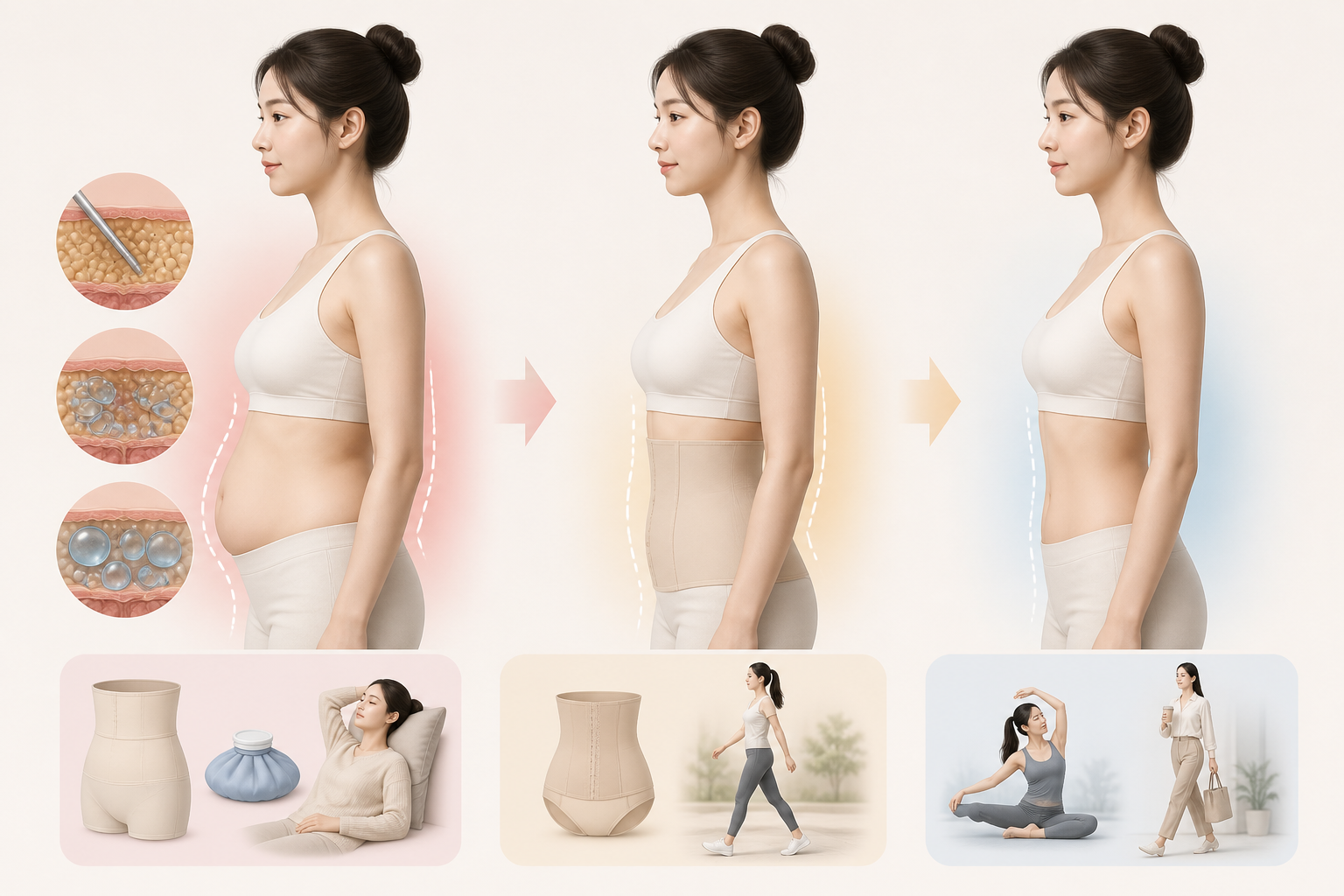
Swelling does not drain away all at once; it changes in stages. You look swollen right after surgery, settle somewhat over a few days, and may then feel residual swelling and firmness through weeks one and two.
The timeline below is a general pattern. Actual recovery varies by area and by individual.
| Stage | What you feel | Planning around it |
|---|---|---|
| Day of surgery to day 3 | Swelling, heaviness, tightness, and bruising are at their most noticeable | Rest, prescribed medication, compression garment and bands |
| Day 4 to 1 week | The major swelling eases and moving gets easier | Light daily activity is fine; avoid strenuous exercise |
| 1 to 2 weeks | Residual swelling, firmness, and hardness can be felt | Returning to work is often possible, with individual variation |
| 3 to 4 weeks | Visible swelling is substantially reduced | Check whether light exercise and treatments can begin |
| 2 to 3 months | The line grows clearer and firmness softens | Radiofrequency and manual treatments can run alongside |
| Around 6 months | Tissue has settled; the final line can be assessed | Plan longer-term care once the course is reviewed |
What matters here is that “when will it all be gone” has no single answer. The visible swelling comes down relatively quickly, but the firmness underneath, the residual swelling, and the skin adapting to a new line continue over months.
How long does facial swelling last?
The face is a smaller area than the body, but the skin is thin and the vessels and lymphatics are fine, so small changes register as large ones. The double chin, jawline, and area below the cheek are especially noticeable, because expression and neck movement never stop.
On the day itself, the solution used and the tissue response can leave the face looking full. A good deal of that temporary swelling is often absorbed within 24 hours. Residual swelling then continues for one to two weeks, and the major swelling generally eases around the one-month mark.
Not everyone looks natural the next day, though. Prior surgery, fibrosis, a tendency to bruise, skin elasticity, and the range treated all change the course.
With the face, what matters is not removing a lot but limiting tissue disturbance and working within the range the skin can follow. In consultation we confirm the fat layer and skin thickness with ultrasound, and look at how the jawline, the double chin, and the area below the cheek connect.
Related: facial liposuction
Arms, abdomen, and thighs can take longer than the face
These areas cover more ground than the face, so swelling, bruising, and the compression period all feel longer.
The arm moves constantly, and the armpit, accessory breast tissue, and side of the chest are often included, so tightness is common early on. The abdomen is involved in sitting and standing, which makes soreness and swelling more noticeable. The thigh is affected by gravity, and swelling can feel as though it is settling around the knee or down toward the calf.
Roughly, by area:
- Arms: major swelling eases in one to two weeks; the line settles over one to three months
- Abdomen: swelling and soreness are noticeable for two to four weeks; the line keeps changing for three to six months
- Thighs: swelling can feel as though it moves downward; thickness and firmness ease gradually over three to six months
- Face and double chin: major swelling eases relatively quickly, but firmness and residual swelling are followed for three to six months
We do not look at one area in isolation but at how the lines connect all the way around. The wider the range, the more the recovery plan matters — so it helps to confirm your work schedule, training plans, and whether you can realistically wear compression before surgery, not after.
Related: liposuction at Line Culture
Is that hard band the same thing as swelling?
Some people say the swelling seems to have gone but they can feel a hard band. That firmness is usually fibrous tissue forming as part of healing — in Korea it is commonly called biobond.
It develops as the space left by the removed fat recovers and the tissue reattaches and settles. It can register as a pulling sensation when you raise your chin, extend your arm, or straighten your back.
It eases over months — substantially reduced by three, more settled by six — though here too there is wide individual variation.
What matters is not to massage hard just because something feels firm. Strong massage or heat-based treatment too early can make swelling and bruising worse. When to start and what kind of treatment to have is a judgment for your medical team, based on the area treated and how recovery is going.
We review the course at one, two, three, and six months and recommend care matched to the stage of recovery rather than to the calendar.
Related: post-surgery care
What actually helps reduce swelling?
The most important thing is giving your body time. Massaging aggressively, or starting saunas and hard training because you want it gone sooner, slows recovery down.
The principles that generally help:
- Wear the compression garment or bands as instructed
- Avoid excessive movement and forceful massage right after surgery
- Avoid alcohol, smoking, saunas, and heated rooms for the period advised
- Cut back on salty food and late-night eating so swelling is not aggravated
- Walk lightly to support circulation; postpone strenuous exercise
- Keep to your medication and follow-up schedule
- Contact the clinic if bruising, heat, or pain increases
A compression garment is not a tool for pressing swelling away. It helps the space left by the removed fat close evenly and the skin adapt to a new line. If it is too loose or folds to one side, the pressure is not delivered evenly — which is why how you wear it matters.
When can I go back to work or see people?
Returning to normal life depends on the area.
After facial liposuction, people with little bruising and modest swelling sometimes resume daily life quite quickly. But for an important shoot, a wedding, or an interview — anything where the face is the focus — allowing at least one to two weeks is more realistic.
Arms, abdomen, and thighs can be covered by clothing, so returning to work is often possible sooner — though standing for long periods, walking a lot, or lifting will increase the recovery burden.
Plan along these lines:
- Desk work: consider returning after a few days depending on area and condition, without pushing early on
- Service or on-site work: allow a longer margin if you stand or move a great deal
- Important events: at least two weeks for the face, three to four for the body
- Exercise: start with light walking; resume strength work after your course is reviewed
We look at the recovery schedule during the pre-operative consultation. Tell us about work, travel, events, and training plans in advance and the scope, the timing, and the aftercare schedule can all be set more realistically.
Signs worth checking when it feels like too long
A degree of swelling and firmness is a natural part of healing. But if the direction is not toward improvement — if pain, heat, redness, or marked asymmetry are increasing — contact the clinic.
Do not judge these alone:
- Swelling on one side that keeps getting worse
- Heat and pain increasing together
- The treated area becoming red, hard, and swollen
- Bruising spreading suddenly, or pain sharply increasing
- Marked skin color change after removing the compression garment
- Significant firmness and irregularity still present past three months
Where we look to shorten recovery
Shortening the swelling period is not only about aftercare. The pre-operative plan, the length of the operation, how much tissue is disturbed, where the incisions go, and the flow of follow-up care are all connected.
We do not decide by impression. Before surgery we use ultrasound, photographic review, a full-length mirror, a pinch test, body composition analysis, and an interview to establish the fat layers, skin elasticity, and muscle condition.
Afterward, a private recovery room, appropriate post-operative support, and clear instructions help you through the first day. From there we review the course at one, two, three, and six months, with care matched to each stage of recovery.
If you are unsure whether the swelling you have now is a common course or something that needs checking, get in touch rather than measuring it alone. We will look at the course and decide together.