Comparing Cellulite Treatments: Start With Your Own Type
Losing weight and still finding the skin on your thighs or buttocks dimpled is frustrating. The scale moved, but the surface still reads like orange peel — and it can stand out more when you cross your legs or stand a certain way.
We call this cellulite. Many people assume removing fat will clear it, but cellulite is not a problem of fat volume alone.
Fat beneath the skin, fibrous septa, fluid retention, circulation, and skin elasticity all act together. So when comparing treatments, the question is not which one is best known but which type of cellulite you actually have.
Why does cellulite form?
It describes a surface that dimples and rises unevenly. It appears most often where there is a fat layer and circulation slows easily — thighs, buttocks, abdomen, the back of the arms.
The key is the structure beneath. As fat cells enlarge or fluid accumulates, they push the skin upward, while fibrous septa pull it down. The difference between those two forces is what shows on the surface.
Several things make it worse.
- Increased fat volume
- Reduced skin elasticity
- Sluggish lymphatic and blood circulation
- Long periods sitting or standing
- Daily habits that lead to repeated fluid retention
- Hormonal changes
- Repeated cycles of rapid weight gain and loss
- Fibrosis following earlier procedures or surgery
Which is why slim people can have it, and why dieting can leave it exactly as it was.
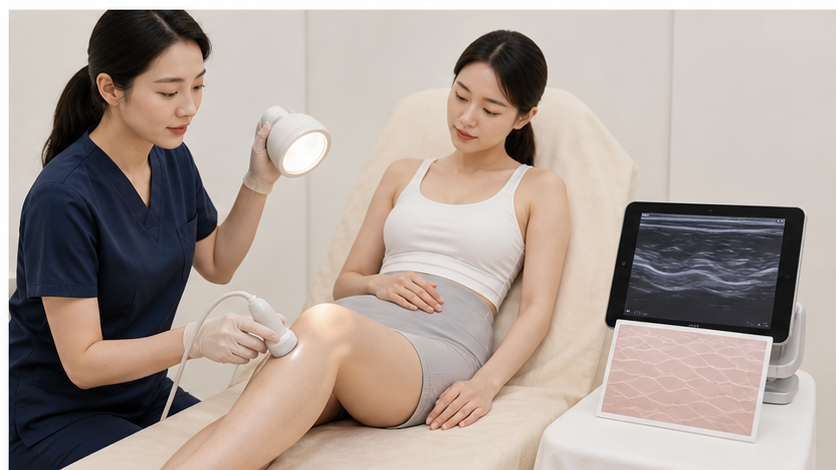
Separate the type first
| Type | What it looks like | Direction |
|---|---|---|
| Fat-dominant | Thick fat layer, with overall circumference also a concern | Liposuction, injectable reduction, weight management |
| Fluid-dominant | Swells and feels heavy depending on the day, late meals, or cycle | Circulation care, daily habits, radiofrequency or shockwave |
| Fibrous | Firm, with clearly defined unevenness | Softening fibrosis — radiofrequency, ultrasound, shockwave |
| Elasticity-dominant | Thin skin with little support, so contours read clearly | Lifting and tightening, skin elasticity care |
Severity varies too. There is a stage visible only when you pinch the skin, a stage visible standing, and a stage visible lying down. The further along it is, the more fat, fibrosis, elasticity, and circulation have to be addressed together rather than with one treatment.
Option 1. Injectable fat reduction
Described as acting on some fat cells and encouraging clearance. It is worth considering in localized areas that pinch — the inner thigh, the abdomen, the upper arm.
It often suits when:
- The fat layer is not especially thick
- You want to refine one specific area slightly
- Surgery feels like too much
- Your schedule cannot accommodate a long recovery
- Fluid and fat feel mixed together
It usually requires repeated sessions, and where the unevenness comes from fibrous septa or skin elasticity, reducing fat alone will not satisfy.
Related: injectable fat reduction
Option 2. Radiofrequency, ultrasound, and shockwave
These come up constantly in cellulite care. Rather than removing large amounts of fat, they are generally aimed at circulation, skin elasticity, softening fibrosis, and improving the condition of the tissue.
They often help when:
- Your legs swell easily and feel heavy
- The surface is uneven but there is not a great deal of fat
- Firmness after liposuction is bothering you
- Reduced elasticity is part of the picture
- You prefer non-invasive care to surgery
Device-based care also tends to need repeated sessions rather than delivering a large change in one.
Option 3. Direct small-volume fat extraction
Rather than dissolving fat and letting it clear, this is described as removing a small amount of fat directly.
It may suit when:
- A small bulge in one specific place is the concern
- There is not a great deal of fat
- Surgery feels like too much but you want more change than an injection gives
- The goal is refining one area rather than changing the whole line
For a broad change — the whole thigh, the outer flare, around the knee, the crease under the buttock — it is limited.
Option 4. Liposuction
This removes fat cells directly. Where there is substantial fat and you want to change a broad line — thighs, abdomen, upper arms — it offers the largest change.
It may suit when:
- The fat layer is thick and widely distributed
- Injections and treatments have not produced enough change
- You want to change the circumference and line of the whole thigh
- The outer flare, above the knee, and the crease below the buttock are all part of it
- You want a method that reduces fat cells themselves
That said, liposuction does not automatically clear cellulite. Suctioning aggressively where cellulite is pronounced can make the unevenness more obvious, not less.
In thigh liposuction we prioritize preventing unevenness, preserving the fat that provides support, and a line that makes the leg read as longer.
Related: thigh liposuction
Option 5. Cellulite-specific procedures
These include releasing fibrous septa, stimulating tissue with heat, ultrasound, or shockwave, and improving skin elasticity.
They are considered when dimpling and an uneven surface are the main concern. Downtime, bruising, discomfort, how long results hold, and which areas suit all vary by device and method.
What matters is that these too have limits on their own where there is a lot of fat.
What to consider first
| Where you are | What to consider first |
|---|---|
| Little fat, with repeated swelling | Radiofrequency, shockwave, circulation care |
| Refining one small area | Injectable reduction, small-volume extraction |
| Whole-thigh circumference and line | Liposuction |
| Surface dimpling is the main problem | Cellulite-specific procedures, tightening |
| Substantial fat and pronounced cellulite | Liposuction combined with aftercare |
| Thin skin with weak elasticity | A lifting and tightening approach |
One treatment is rarely the whole answer
Cellulite is made by fat, fibrous septa, fluid, circulation, and skin elasticity together. Reducing fat does not always smooth the surface, and treatments alone do not substantially reduce circumference.
Where the fat layer is thick and widely distributed, liposuction is the more realistic choice. Where there is not much fat but surface unevenness and swelling dominate, radiofrequency, shockwave, lifting and tightening, or cellulite-specific procedures suit better.
At Line Culture Clinic, in a private space near Exit 3 of Apgujeong Station, we establish the current state of your fat layers and skin first, then discuss the direction that fits your body.
Results, recovery time, swelling, bruising, scarring, pigmentation, discomfort, and unevenness all vary from person to person. If you cannot tell which type you have, start with an assessment.