Arm Liposuction Recovery: From Day One to Three Months
The time you spent researching before deciding on surgery was probably not short. What people look up most in that process is recovery. What the day itself is like, what day eight is like, whether a month wraps it up.
Search and you mostly find reviews. A review is that person’s course, so it helps as a reference, but it does not tell you whether your current state falls within the common range. So let us set out, stage by stage, what is common and what is a signal.
Arm recovery is not one block but a series of stages
There is a reason arm liposuction recovery is hard to state as a single number: what happens in the body differs by stage.
The first few days are when tumescent fluid and edema drain away. Next comes the stage where tissue heals and knits together. Firmness or hardness appears here and gradually eases. The last is the stage where that firmness resolves and the surface smooths out. Because the three stages differ in character, the same symptom means different things depending on when it appears.
Feeling something hard at week three and feeling the same thing at month three are different stories. The first is a common course; the second warrants a look. This is why you have to check the timing first when reading reviews.
The length of each stage varies as well. Treating the arm alone within a narrow area and extending into the armpit and bra line produce different timelines for swelling to clear. If skin elasticity is on the lower side, the final stage of surface smoothing runs longer. So even two people who had the same surgery on the same day do not progress in step. That is why you cannot use someone else’s timetable as your own.
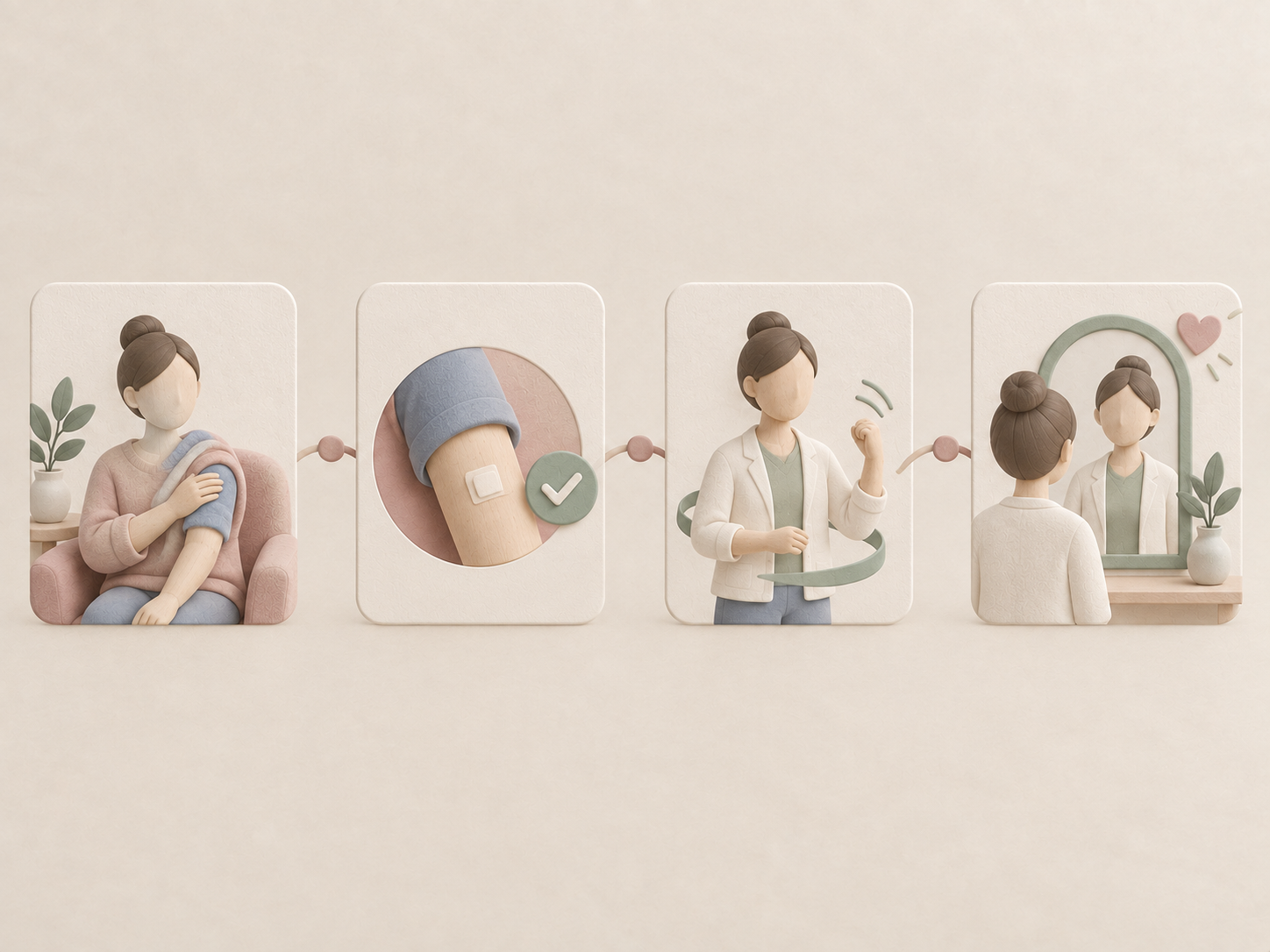
Day one to day three, the most conspicuous stretch
Right after surgery the arm actually looks thicker. You may wonder why, when fat was removed, but the solution introduced for anesthesia and the early edema are still inside. Thickness at this stage has no bearing on the result.
Pain arrives less at the incision sites than as a general ache through the whole arm. Many people describe it as similar to muscle soreness the day after a hard workout. Raising the arm or washing your hair is at its most awkward during this stretch.
There is a reason that ache does not come from the incisions. Liposuction passes broadly along the layer beneath the skin, so the disturbance covers the whole area traversed rather than the entry points. The pain is therefore felt spread across the arm rather than at one spot. After a few days it shifts into hurting only when pressed.
Swelling starts right after surgery and tends to peak between 48 and 72 hours. Being more swollen on the second day than the first may make you think something has gone wrong, but it is the usual order. Bruising also darkens around then. Its extent follows the treated area, so if the whole arm was addressed it can spread down below the armpit.
Swelling lasts longer on the arm than on other areas. Lymphatic drainage and venous return are both easily affected in the arm, so for the same volume removed, swelling clears later than on the abdomen. If you set expectations for arm recovery using abdominal timelines, it will feel slow.
What changes around suture removal?
Many people ask what day eight is like, and that question is really about the timing of suture removal. Sutures usually come out between one and two weeks, varying with the number of entry sites and how fast they heal. What you feel shifts considerably on either side of it.
Until the sutures are out, movement is limited by caution around the incisions. You shower while avoiding the area. Once they are out, that constraint disappears and swelling starts to fall noticeably. Recovery has not suddenly accelerated; what had been progressing all along simply becomes visible from this point.
Entry sites are placed along the inner arm or the crease of the armpit. With the arm lowered they fold away or stay hidden, so the angles at which they are exposed in daily life are limited. Redness remains for several months even after the sutures come out. That is part of healing, and the color fades with time. A scar generally takes six months or more to settle.
Some people find the surface uneven during this period. Swelling can pool locally as the tissue heals, and a phenomenon called adhesion can occur. Put simply, layers partially stick together as the treated area heals, and in most cases it resolves with time. If there is a large difference between sides, however, or one side alone is unusually hard, that warrants a look.
Three weeks to one month, still early
This is the stretch where people waver most. The swelling has come down to a degree but the line is not emerging as hoped, and it starts to feel like a failure.
In reality, residual swelling is still present. Swelling divides broadly into three stretches: several days to two weeks while acute inflammation subsides, two weeks to three months while the shape visibly resolves, and after that a stretch where fine swelling remains and slowly clears. Three weeks is the beginning of the second stretch, so it is not yet a place where answers appear. Reaching for a tape measure here gives an ambiguous number as well.
This is also the stretch when people read the most reviews. Yet even among reviews at the same three-week mark, the treated areas differ and the original fat layers differ, so they do not compare. Reading that someone else already has their line makes you anxious, but that person may have had less to remove in the first place, or better elasticity. Your comparison is not someone else’s week three; it is your own week one.
What is called fibrosis also becomes pronounced around now. The treated area feels hard and lumpy to the touch — put simply, the tissue temporarily firms as it heals. It is not a complication but part of recovery, and it typically begins to soften around the one-month mark and resolves over three to six months. If one side alone is unusually severe, however, or the area feels like it is widening, that warrants a look.
By about a month, raising the arms overhead generally becomes comfortable. Change is felt first in how clothes fit. We do recommend keeping photographs. Looking every day makes you miss the change, but placing week three and week four side by side, shot from the same angle, shows the difference. If the angle and lighting are not matched there is nothing to compare, so keep the conditions of your first photo exactly.
Two to three months, where you assess the result
This is when the firmness eases and the surface resolves. Past two months, the hardness you could feel diminishes and the line with the arm raised settles.
Differences between the two sides sometimes become noticeable in this stretch. Arms that are perfectly symmetrical to begin with are rare, so the original difference the swelling had been covering is only now visible. Whether it is a difference created by surgery or one that was already there separates out when compared against pre-surgery photographs. That is where our advice to photograph several angles at the start comes from.
Returning to exercise also falls in this stretch. Light upper-body work is considered from around two months, while heavy lifting comes somewhat later, because large swinging or pulling motions put force on layers that are still healing.
| Stage | Common state | What you can do with the arm |
|---|---|---|
| Day of surgery | Looks thicker; aching pain | Light movement |
| Days 1 to 3 | Swelling peaks at 48 to 72 hours; bruising darkens | Raising the arm is uncomfortable |
| Around suture removal (7 to 14 days) | Swelling starts to fall | Movement restrictions lifted |
| 3 weeks | Residual swelling; partial hardness | Most everyday movements |
| 4 to 6 weeks | Change felt in how clothes fit | Raising arms overhead is comfortable |
| 1 to 2 months | Firmness begins to soften | Light upper-body exercise |
| 3 to 6 months | Firmness resolves; the line settles | Most restrictions lifted |
We allow three to six months to the final assessment. Where a large volume was removed or skin elasticity is low, it can run from six months to a year. This table is a common course, though, and where a wide area was treated or the patient is older, each stage shifts later. Progressing differently from person to person, even with surgery on the same day, is normal.
When you can resume which everyday movements, and how far, is set out separately on the Post-Surgery Care page.
Every stage has signals worth telling us about
The same symptom can be a common course or a signal that warrants a look, depending on when it appears.
| Stage | Tell us when |
|---|---|
| Day of surgery to day 3 | One side swells rapidly, or heat accompanies it |
| Days 3 to 7 | Pain eases and then worsens again |
| Around suture removal | Discharge continues from an incision site |
| 3 weeks to 1 month | One side hardens and the area widens |
| 2 to 3 months | The firmness does not ease at all |
Hold to one standard. If it is improving even slightly week over week, you can wait. When it stays the same or feels like it is widening, that is when to tell us. If you cannot tell which it is, you can tell us that too.
What the surgery determines ends here. The other half is decided during recovery, and that stretch is best watched with someone who knows your starting state. It is why we say the day of surgery is not the end but the middle.
When something ambiguous comes up during recovery, whether to wait or to have it examined is settled fastest by the people who know your starting state. That is why at Line Culture Clinic the person who performed the surgery also follows the course. If you are unsure whether the stage you are in is a common one, do not measure alone — get in touch.